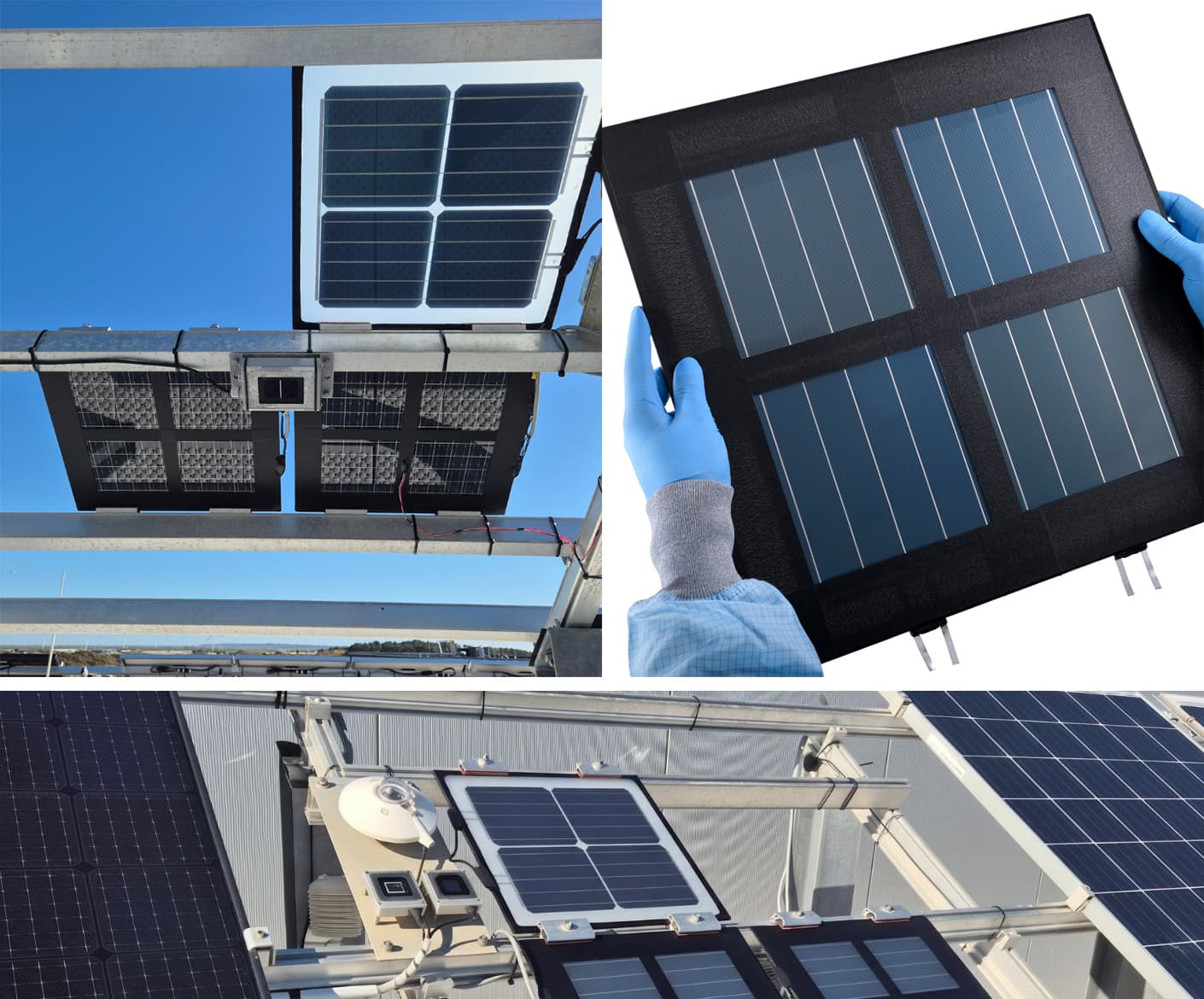
Bifacial tandem solar technology has taken a major step towards mass production. For the first time, it has been shown that these solar cells can be manufactured at industrial scale, while tests confirm they generate 15 to 30% more power from the same surface area. For a sector grappling with limited roof space, grid congestion and rising energy costs, that is not a detail but a potential game-changer for sustainable production.
What sets bifacial tandem cells apart
A conventional solar cell mainly captures light on its front face and efficiently converts only part of the solar spectrum. Two innovations converge here. Bifacial means the cell also captures light on its rear side — reflected from a roof, façade or the ground. Tandem means two semiconductor layers are stacked, each tuned to a different part of the spectrum. Often this involves a perovskite layer on top of classic silicon.
The combination sharply increases yield per square metre. That is precisely the metric that matters once available surface becomes scarce. The real breakthrough, however, lies not only in laboratory efficiency but in the proof that production scales with existing industrial processes.
From lab setup to industrial production
The leap from a working prototype to reproducible mass production is notoriously difficult. Perovskite layers are sensitive to moisture, temperature and process variation. To make the technology affordable, deposition, coating and encapsulation must run reliably and at high throughput. Critical focus areas include:
- Coating and deposition techniques that deliver homogeneous layers at large format — a field where expertise in industrial chemistry, adhesives and coatings is indispensable.
- Encapsulation and barrier layers that keep moisture out and safeguard lifespan, often based on advanced foil and film.
- Process control and inspection to detect defects early; here machine vision and industrial AI play a growing role.
- Automated assembly for consistent quality at high volumes.
Why this fits broader trends
The energy transition places enormous pressure on manufacturing. Production halls have large roofs, yet grid capacity and surface area are finite. More output per square metre means a company can cover a larger share of its own consumption with the same roof, or export more before the grid connection becomes a bottleneck. That makes self-generation financially more attractive and reduces exposure to volatile energy prices.
At the same time, this development strengthens Europe's ambition to bring solar manufacturing partly back home. In recent years, production shifted largely to Asia. A technological lead in high-efficiency cells, coupled with scalable production, offers European manufacturers and suppliers a chance to add value in the chain again — from materials and machine building to system integration.
Opportunities for suppliers
A new generation of solar cells creates demand across the entire supply chain. Think of precision materials, coatings, encapsulation films, measurement and test equipment, and production lines. Companies investing now in knowledge of perovskite and tandem processes position themselves early in a market expected to grow strongly.
- Material suppliers for substrates, coatings and barrier layers.
- Machine builders developing deposition and encapsulation lines.
- Test specialists for reliability, lifespan and certification.
- Installers and integrators translating the higher yield into concrete business cases.
What this means for manufacturing
High-efficiency solar technology that is industrially producible will, over time, lower the cost per kilowatt-hour generated and make self-sufficiency achievable on limited surfaces. For production managers and technical directors, this is a signal to reassess energy strategy and roof utilisation. For suppliers in materials, machine building and automation, a concrete growth market is emerging. Those who engage the right partners in time can benefit from a transition that is accelerating both technically and economically.