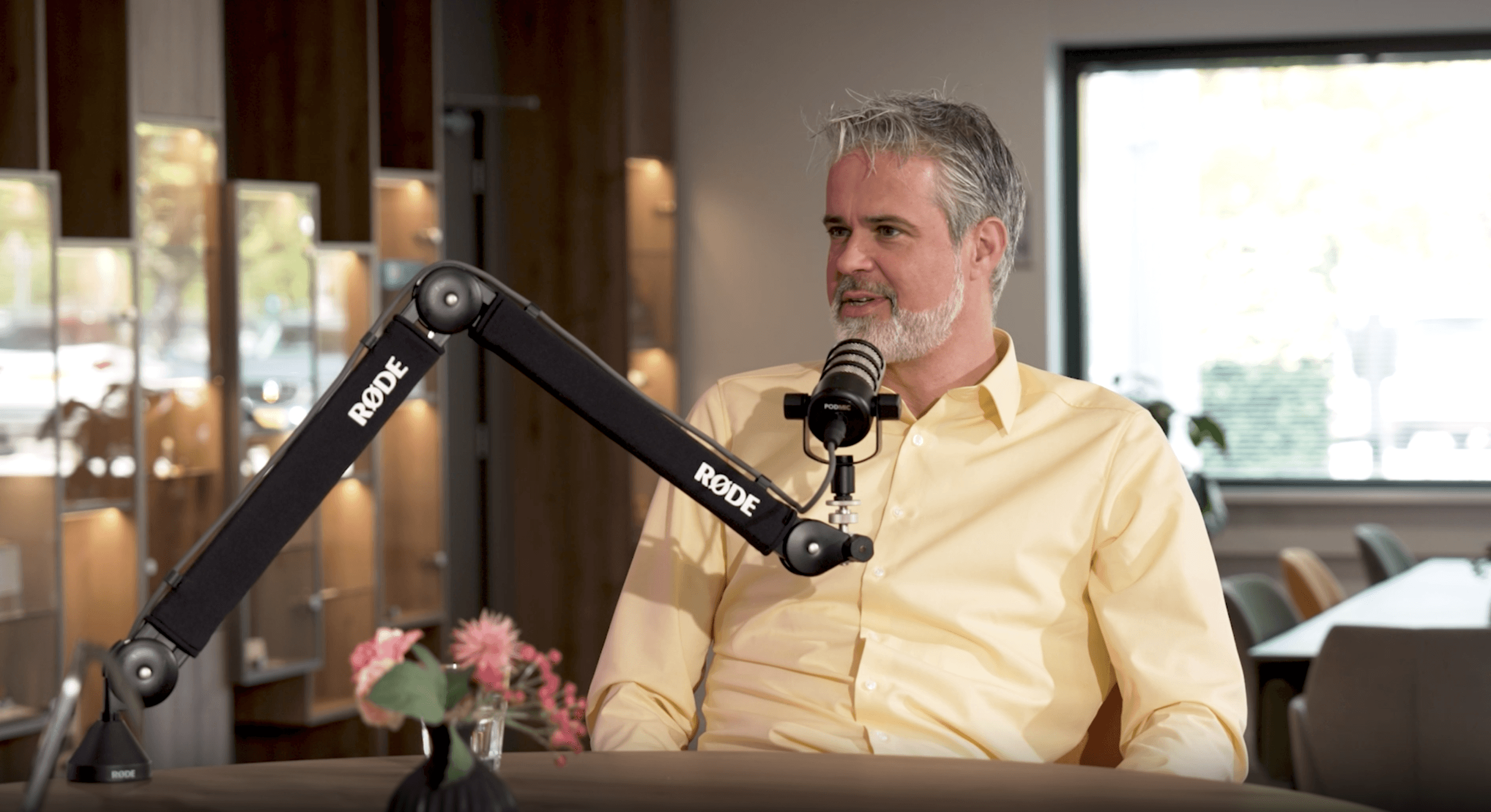
For years, the Dutch manufacturing industry was able to shift toward more complex work. Simple production moved to low-wage countries, while the Netherlands positioned itself ever more strongly in high-tech, precision and complex machine building. That model has brought a great deal, but according to Edwin de Zeeuw, director of Mikrocentrum, it is also starting to grind. Because if you let the simpler work go, you also lose part of your manufacturing knowledge, the breadth of your supply chain and ultimately perhaps even the very foundation beneath the complexity in which you have become so good.
That is why, according to Edwin de Zeeuw, automation is not a luxury project but a necessary next step. Not only to produce more efficiently, but to prevent companies from falling structurally behind in a market that is already undergoing a painful reshuffle.
Simple work disappeared, and with it a piece of manufacturing knowledge
According to Edwin de Zeeuw, the Netherlands has moved ever further “up in the value chain” over the past decades. Because we became too expensive here for simple work, that work increasingly went abroad. What remained was more complex work: high-precision machine building, high-tech assembly and specialist systems, driven by players such as Philips, ASML and Thermo Fisher.
This has brought the Netherlands a great deal. But according to Edwin de Zeeuw it also raises an uncomfortable question: how long can you continue to dominate the top of the chain if the lower layer keeps crumbling? After all, when production disappears, so does experience, process knowledge and the ability to keep building a complete solution as a chain.
Saying in hindsight that companies should have automated is too easy
The logical counter-question, of course, is: should those companies have automated sooner? In theory, yes, but Edwin de Zeeuw immediately adds an important nuance. Because automation demands vision, courage and above all money. And that last point in particular was not a given for many smaller companies in the manufacturing industry. Margins have rarely been extremely high. Many businesses simply did not have enough fat on the bones to keep making large investments over and over again.
You now see this reflected in the market. Some companies were early enough, built up a lead and continue to grow. Others are stuck between rising demands, investment pressure and too little financial room to really catch up.
Those who don't invest ultimately hit a wall
Edwin de Zeeuw is remarkably clear about what happens if companies fail to invest in automation. In that case, he says, you simply cannot keep it up in the end. It often starts small: it becomes a little harder to stay competitive, a little harder to find people, a little harder to hold on to your margins. But at a certain point it really starts to grind. And anyone who has not invested by then ends up in a bind. You are behind, but at the same time you no longer have the room to properly close that gap.
Banks become more cautious, figures deteriorate and the gap with the frontrunners only grows wider. According to Edwin de Zeeuw, this shake-out is already underway. Companies collapse, are taken over or are absorbed in advance into larger groups that do have the means to invest.
The high-tech chain has itself become more vulnerable
An additional complication is that the market itself has become more erratic. Edwin de Zeeuw explicitly points to the dynamics around ASML, where years of strong growth encouraged suppliers to scale up, hire people and invest in new machinery. But as soon as such a market movement flattens or temporarily reverses, those investments also turn out to be a source of vulnerability.
That makes the playing field complex. Large OEMs tell their suppliers not to become too dependent on a single customer, yet at the same time expect those same suppliers to be fully ready to deliver at peak moments. According to Edwin de Zeeuw, this tension is not unique to high-tech, but over the past year it was extra visible in that sector.
The solution lies not only in machines, but in stronger chains
According to Edwin de Zeeuw, the future of the manufacturing industry will therefore not be determined solely by machines or software, but precisely by the quality of collaboration within the ecosystem. Knowing one another, trusting each other's roles and communicating honestly about what is and isn't possible are, in his view, essential. That requires human interaction. Not just digital processes and portals, but real conversations between the companies that together form the chain.
That is also why Mikrocentrum believes so strongly in physically bringing people together. Not out of nostalgia, but because, according to Edwin de Zeeuw, systemic change only comes about when companies know each other, keep talking to one another and jointly figure out what the model of the future should look like.
The real change is systemic, not local
One of the strongest observations in the conversation is that the existing system worked for a very long time, but is now under pressure. According to Edwin de Zeeuw, what is needed is not just optimization, but almost a systemic change. This means it is no longer enough to make just a few improvements at company level. The question has become bigger: how does the entire chain of clients, suppliers, integrators and knowledge partners keep functioning in a new reality?
That reality revolves around greater complexity, greater investment pressure, staff shortages and a chain that is no longer automatically stable.
Automation is therefore much bigger than an internal project
That is why, according to Edwin de Zeeuw, automation is broader than an internal efficiency improvement. It is not just about a robot on the shop floor or a software tool in engineering, but about the chain's ability to keep work here, adapt faster and produce more intelligently. Companies that lead the way create room to move with the market. Companies that keep waiting become increasingly dependent on a market that has grown less forgiving.
Why Mikrocentrum continues to focus on physical encounters
Edwin de Zeeuw also explains why Mikrocentrum wants to play a role in this. According to him, the strength of the platform lies precisely in physically bringing people together around technology. Not only through trade fairs, but also through training, courses and encounters between engineers, developers and companies in the high-tech manufacturing industry.
That chance encounter is, according to Edwin de Zeeuw, anything but non-committal. It makes it possible to see new solutions, find partners and look at the same problem from multiple angles. That is exactly what is needed in a period in which companies no longer only have to optimize their own organization, but must once again understand their place in a changing chain.
Automation Experience should wake companies up
In that light, Edwin de Zeeuw also places the event Automation Experience. According to him, the strength of such a physical exhibition floor lies precisely in the fact that a broad perspective comes together there. You do not just see a single technology or one supplier, but a complete field of integration parties, suppliers and real-world examples.
That makes it more efficient for companies to explore where they stand, what is available and which questions they should actually be asking. Not every company has to figure out everything on its own. Sometimes progress simply begins with seeing solutions that already exist elsewhere.
Those who keep hesitating mainly lose time
Asked what he would like to give companies that are still hesitating, Edwin de Zeeuw returns to the same core: you don't have to solve everything at once, but you do have to get moving. Because if you keep postponing, the change will eventually happen to you. And then there is far less room to still choose a direction yourself.
That is perhaps the sharpest message from this conversation. Today, not automating is also a choice. It's just one that will become increasingly hard to sustain in the coming years.
Conclusion
The analysis by Edwin de Zeeuw is clear: the manufacturing industry can no longer coast on the model that worked for years. Simple work has disappeared, the chain has become more vulnerable and companies that wait too long to invest increasingly get into trouble faster. Automation is therefore not a project for later, but a precondition for being able to keep participating at all.
At the same time, the solution is not solely technological. It is just as much about preserving knowledge, collaboration across the chain and the courage to invest earlier than feels comfortable. Those who fail to do so will, according to Edwin de Zeeuw, ultimately not only fall behind, but risk simply disappearing from view.
FAQ
Who is Edwin de Zeeuw?
Edwin de Zeeuw has been director of Mikrocentrum since October 2023 and has a background in technology, the high-tech manufacturing industry, innovation and startups.
What does Edwin de Zeeuw see as the biggest change in the manufacturing industry?
That simpler work has increasingly disappeared abroad, while the Netherlands shifts toward more complex production. As a result, the knowledge base is also under pressure.
Why is automation so important according to Edwin de Zeeuw?
Because without investments in automation, companies ultimately fail to remain competitive and get stuck in a market that is becoming increasingly selective.
What does Edwin de Zeeuw mean by systemic change?
That it is not only individual companies that must improve, but that the entire chain of clients, suppliers and partners must start collaborating differently.
Why does Mikrocentrum believe so strongly in physical events?
Because physical encounters help to share knowledge, build trust and bring together solutions from multiple perspectives.