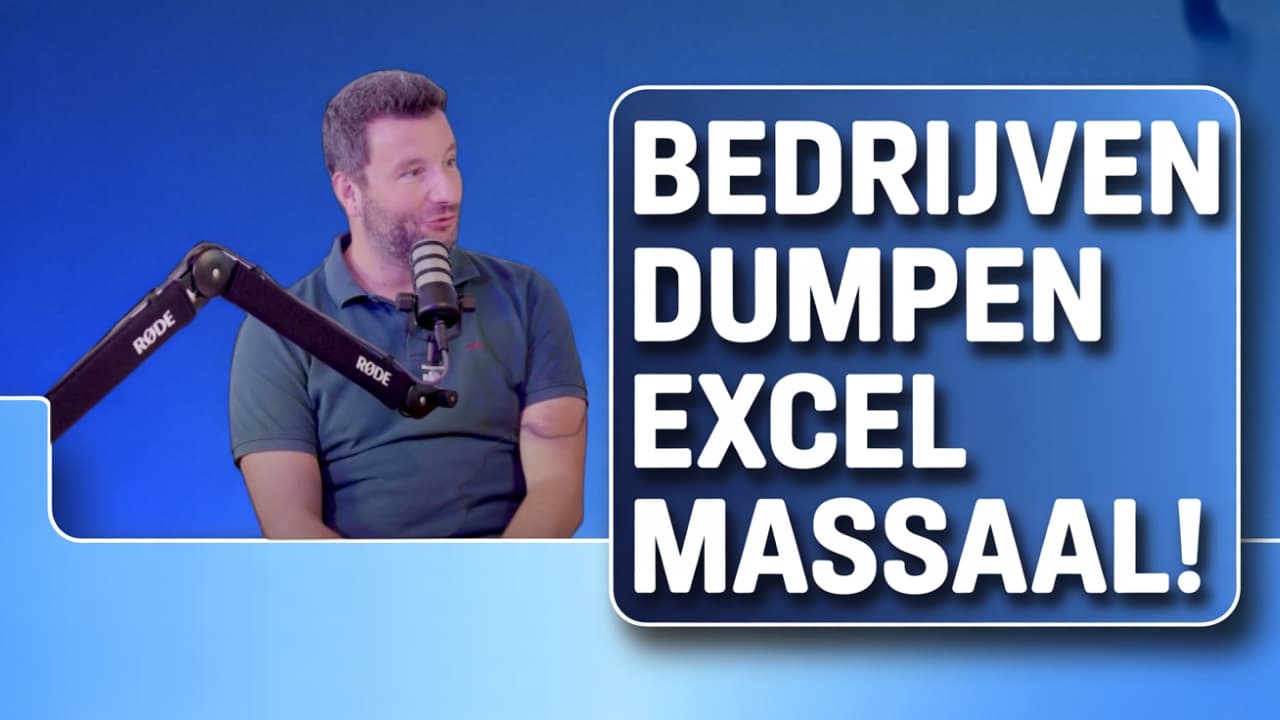
The hidden IT pitfall in manufacturing
Every factory or wholesaler knows the story: endless Excel files, version 0.1, 0.2, and still nobody knows the truth. According to Mark, commercial lead for Digital Transformation at Oliver IT, this is precisely the moment when companies need to step in.
“Excel seems convenient, but it's often proof that your process no longer works,” he says. “Companies unknowingly lose 10 to 15 percent efficiency because of it.”
Simplicity as the new standard
Oliver IT is not just any IT company. With the slogan “Redefining Simplicity”, they set a clear tone in a world that often communicates in overly technical and complex terms.
Mark explains: “We believe that IT only becomes valuable when it's simple. We don't talk about technology, but about an organization's vision, ambition and processes. IT should be supportive, not leading.”
The idea behind Oliver IT comes from founder Gerben Moeland, who drew inspiration from chef Jamie Oliver: combining different ingredients to create something unique. “We do exactly the same thing, but with technology,” Mark says. “We combine tools, ideas and methodologies to create the perfect recipe for each client.”
From strategy to execution: Think, Build, Run
What sets Oliver IT apart is their practical approach. “We work with the Think – Build – Run methodology,” Mark explains.
- Think: mapping out, together with the company, where it wants to go and where the bottlenecks are.
- Build: developing or selecting the solution that best fits.
- Run: implementing, measuring and optimizing.
“It's not a standard IT project,” he emphasizes. “We start with people and processes, not with software.”
Next and Move: structure in digital transformation
Under the Oliver IT banner are two powerful propositions: Next and Move.
Next is the methodology for digital transformation, in which companies quickly learn where their processes get stuck and how they can improve them.
“During Next, we map out an organization's strategy, mission and processes,” Mark says. “From that emerges a roadmap: a concrete plan devised and supported by the employees themselves.”
Move is then the execution of that roadmap. “Companies often ask: can you now also help us carry out this plan? That's exactly what Move does. We guide the implementation, from software selection to integration.”
From Excel chaos to efficiency and insight
A common problem Oliver IT encounters is companies getting stuck in their own Excel structures.
“At manufacturing companies, we still see crucial information scattered across countless spreadsheets,” Mark says. “So much time is spent updating Excel files that processes grind to a halt. Just by automating that, we often achieve 10 to 15 percent efficiency gains.”
According to Mark, Excel is often a symptom of distrust. “People pull exports because they don't trust the system. Then you get multiple versions of files and nobody knows what the truth is. That's not sustainable. Once you've reached that point, it's time for a system you can actually rely on.”
Custom or standard software? The process decides
Unlike many IT companies, Oliver IT is not tied to fixed brands or platforms. “We're logo-less,” Mark says. “It doesn't matter to us whether a client chooses SAP, Microsoft or something else – as long as it works for the process.”
Still, he defends custom solutions where necessary. “If your process is unique, you should keep it. That's precisely what sets you apart from the rest. In that case, custom development can be the right choice. But if your process is standard, then choose standard software too.”
Workshops: the key to buy-in
An important part of Oliver IT's approach is involving employees at every level of the organization. “Digital transformation is people's work,” Mark says. “We organize workshops with both management and the key users on the shop floor. Those people know exactly where things get stuck.”
The result: plans that are not imposed from the outside, but supported from within. “That's why our roadmaps work. The employees came up with them themselves; we merely facilitated it.”
Measurable results: less waste, more profit
The results of Oliver IT's approach are concrete.
“At clients in the manufacturing industry, we see efficiency improvements of 5 to 15 percent,” Mark says. “That amounts to thousands of euros per employee per year. On top of that, we prevent bad investments because companies finally understand which technology they really need.”
Companies that execute their roadmap well also see growth on the revenue side. “By using data and AI intelligently, new insights emerge and even new markets open up. That's the moment when digitalization starts to pay off.”
The first step: pause and take stock
Mark closes with a clear message: “Everyone wants to do something with AI or automation, but most companies skip steps. Our message is simple: don't start with technology, start with your processes. First get a clear picture of where you really stand.”
Companies that want to know where their opportunities lie can get started quickly, he says. “A Next trajectory takes on average two to three months. Not a full-time investment, but nine half-day workshops. That gives you a complete picture of your processes as well as a plan to improve.”
About Oliver IT
Oliver IT helps organizations in manufacturing, wholesale and retail simplify their IT landscape and accelerate digital transformation. With their Think – Build – Run approach and their Next and Move methodologies, they bring strategy, processes and technology together in one clear structure.
More information: www.oliver-it.nl