Manufacturing companies are investing heavily in smart machines, robots and automated production cells. Yet something striking happens in many factories: amid all that high-tech, a forklift driver is still standing around waiting. Or an employee with a pallet truck. Internal logistics turns out to be the forgotten link in today's factory.
Machines are getting smarter, but the factory is waiting
The manufacturing industry is automating at a rapid pace. Machines are becoming faster, more precise and increasingly autonomous. Entire production cells run with minimal human intervention. But anyone who walks into an average production hall sees something that no longer seems to fit that picture: pallets moved by hand, operators leaving their machines to search for materials, and internal transport flows that depend on chance.
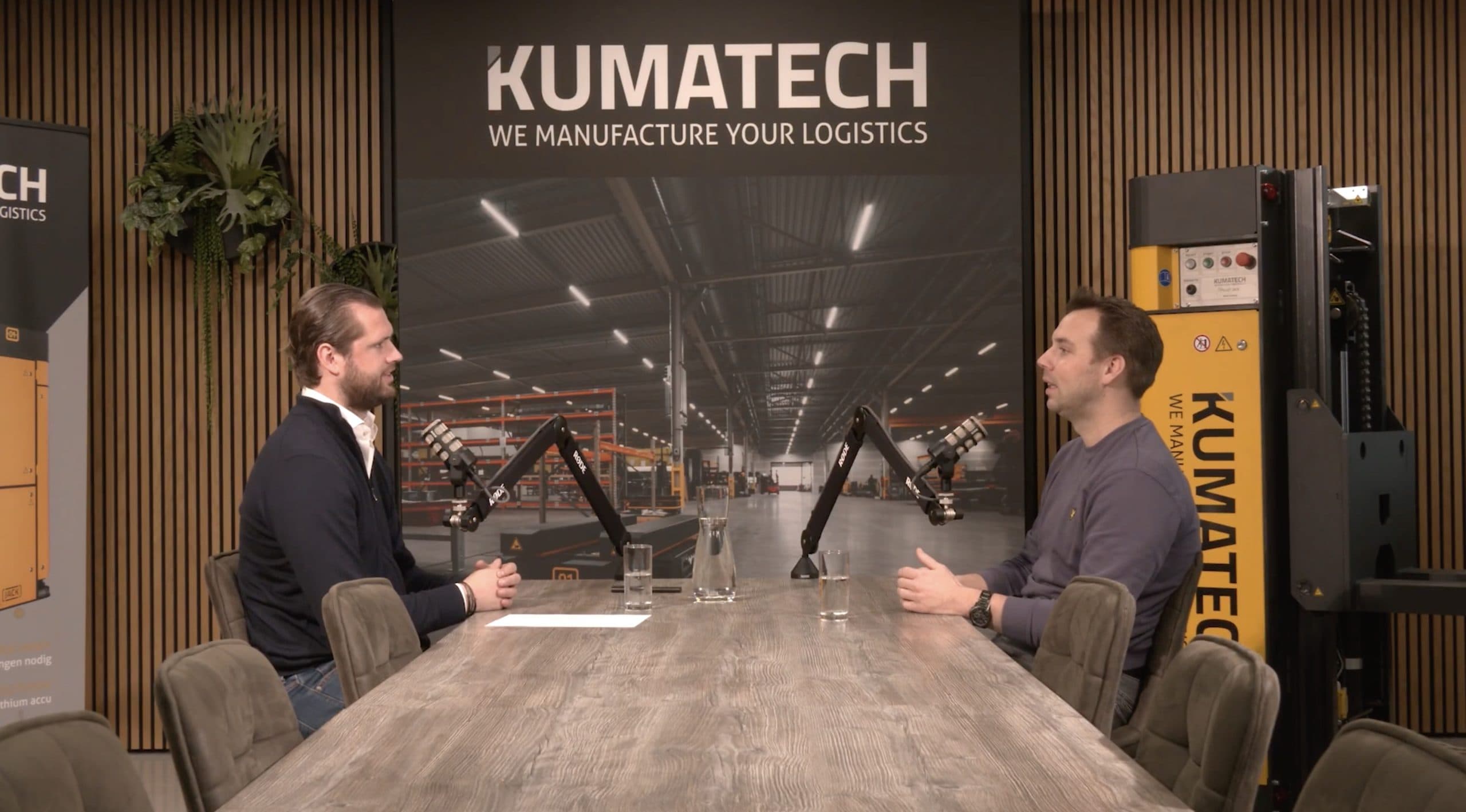
According to John Jaspers of Kumatech, this is not the exception but rather the norm.
"Machines have developed enormously," he says. "But in many companies internal logistics is still manual, fragmented and vulnerable."
The invisible bottleneck in modern factories
Precisely because internal logistics is often seen as 'part of the deal', the problem stays under the radar for a long time. It doesn't appear as a separate line item on the balance sheet, but it translates into lost time, waiting times and inefficient use of staff.
"That pallet truck is always in the wrong place at the wrong time," says Jaspers. "And meanwhile an expensive machine sits idle or an operator walks away from their workstation."
At a time when skilled staff are scarce, that problem is becoming increasingly urgent. The question is no longer whether companies need to work more efficiently, but where they can achieve the greatest gains.
Why internal logistics is now high on the agenda
Since 2018, Kumatech has noticed a clear shift in conversations with manufacturing companies. Where automation revolved for years mainly around machines, internal logistics now increasingly comes up as the next step.
"When we asked customers where we could really still help, the same answer kept coming up," Jaspers recounts. "The machines run well. But everything in between costs time, people and money."
Internal logistics adds no direct value to the product. It's overhead. And that is precisely why it is a logical place to automate.
Why factories still cling to forklifts
Despite these insights, forklifts and pallet trucks remain dominant in production environments. That has little to do with effectiveness and everything to do with habit.
"It's traditional. It's proven. It works," says Jaspers. "So companies stick with what they know."
Yet that picture is starting to shift. Staff shortages, safety issues and scalability are forcing companies to take a fresh look at their internal transport. More and more often the discussion arises: do we buy yet another forklift, or do we now really take the step to automation?
AGVs as the logical next step
This is where AGVs (Automated Guided Vehicles) come into the picture. Not as futuristic gadgets, but as practical building blocks for automating internal logistics.
Kumatech develops and builds these solutions entirely in the Netherlands, focused on manufacturing companies. Often it involves fixed carriers such as pallets, welding jigs or customer-specific carriers.
"Start small, but think big," says Jaspers. "The first AGV has to be a success. You have to end up missing it."
Low-hanging fruit: start small, get results fast
A common mistake is that companies want to automate internal logistics fully in one go. That increases the risk of failure. Kumatech therefore advises starting with clear, repetitive transports.
"Grab the low-hanging fruit," says Jaspers. "A-to-B transports that recur every day."
Think of:
- Departments that are historically awkwardly spread apart
- Shipping located on the other side of the building
- Organically grown factories without a logical flow
It is precisely there that AGVs can quickly prove their value.
Automating is organising
An important detail: an AGV does not solve messy processes. Structure is a requirement.
"Automating is organising," says Jaspers. "You need fixed pick and drop points and clear agreements."
That is why Kumatech deliberately chooses AGVs with fixed routes rather than fully free AMRs. "You don't park your car in the middle of the motorway. It's the same with pallets."
Calm and safety on the shop floor
An underrated advantage of automated internal transport is safety. Forklifts depend on human behaviour and visibility. AGVs work predictably and consistently.
"Safer than a forklift," Jaspers states. "Less damage, fewer injuries and, above all, more calm."
That calm translates directly to the organisation. Production steps connect better, shipping knows what's coming, and employees have to improvise less.
"It becomes a continuous process," says Jaspers. "And continuity is more powerful than speed."
Payback time: often faster than expected
A persistent misconception is that AGVs are complex and expensive. In practice, the business case often turns out to be surprisingly clear.
"If you save six logistics hours per day, you've paid off an AGV within a year," Jaspers explains. "But even with three hours you're often fine within two years."
Most projects end up with a payback period of between one and three years.
Not a question of whether, but when
According to Jaspers, the development is irreversible. Just as robots are now standard in production processes, AGVs will become standard in internal logistics.
"It's no longer a question of whether you start," he says. "It's when."
For companies considering a new forklift, dealing with safety issues, or working towards a lights-out factory, this is the moment to take a serious look at internal logistics.
Conclusion: internal logistics determines your scalability
The factory of the future is defined not only by machines and software, but by everything that happens in between. Internal logistics is no longer a side issue, but a strategic factor.
Anyone who produces high-tech but transports manually is structurally leaving value on the table.
Or as they increasingly say on the shop floor:
Whoever does not automate their internal logistics automates their delay.