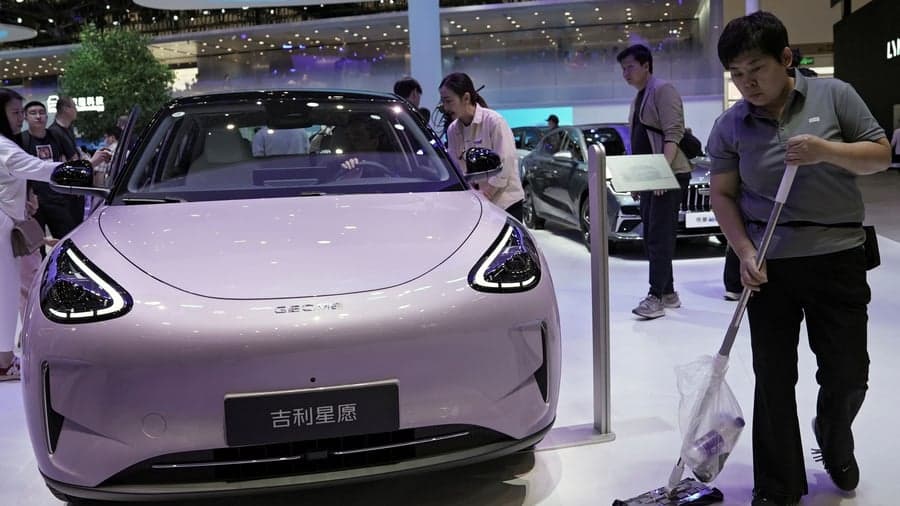
Chinese carmaker Geely is a case study in how quickly the balance of power in the global automotive industry is shifting: despite weak demand at home, profit is rising, driven by sharply growing exports. For European manufacturing, that combination — Chinese car exports as a growth engine while the home market stagnates — is an important signal, because it touches prices, volumes and the competitive position of the entire supply chain.
Why Geely leans on exports
China's car market is grappling with overcapacity, a fierce price war and cooling consumer demand. In that climate, manufacturers turn to foreign markets. Geely is focusing explicitly on exporting electric and hybrid models to Europe, Southeast Asia and Latin America, among other regions. Key drivers include:
- Domestic overcapacity: more production capacity than the home market can absorb, making exports an outlet.
- Economies of scale: high production volumes push down unit costs, enabling aggressive export pricing.
- Brand portfolio: through multiple brands and international stakes, Geely gains access to Western markets and technology.
Yet pressure remains high. Market leader BYD sets the pace on price and speed with its tightly integrated battery and drivetrain technology. Geely must therefore keep fighting for margin and market share both in China and on export markets.
What China's push means for European manufacturers
The rise of Chinese EV brands is not a distant story. It is reshaping demand for suppliers in metal, plastics, electronics and assembly. Some concrete consequences:
- Price pressure across the chain: aggressive export pricing forces European OEMs to cut costs too, which flows through to suppliers.
- Shifting volumes: if European buyers increasingly choose Chinese models, the order book changes for local system integration and OEM outsourcing.
- New opportunities: Chinese manufacturers that produce or assemble in Europe need local suppliers for drivetrain technology and electronics and printed circuit boards.
That last dynamic is crucial. Trade policy — such as import tariffs on Chinese electric cars — makes local production in Europe more attractive. For Dutch and German suppliers this creates a double-edged sword: tougher competition on finished products on the one hand, but new customers wanting to source nearby to ensure supply security and comply with European rules on the other.
The role of efficiency and automation
The cost gap with Chinese manufacturers is partly a matter of scale and partly a matter of efficiency. European manufacturers that want to keep up are investing in smarter processes. Robotics and automation lower labour cost per part and improve consistency — precisely what high volumes demand. Digitalising the production floor also helps to switch faster between orders and variants.
Key priorities for suppliers:
- Flexible capacity: the ability to scale up and down as order volumes from shifting OEMs fluctuate.
- Quality and certification: both European and Chinese OEMs impose strict requirements; demonstrable quality assurance is a prerequisite.
- Material position: secure access to metals and other raw materials becomes more strategic as chains shift.
Electrification as the common thread
Geely's export success rests largely on electrified models. That underlines a broader trend: the car's value chain is shifting from classic combustion components toward batteries, power electronics and software. For suppliers that historically relied on the internal combustion engine, parts of their portfolio are shrinking, while new opportunities emerge in housings, cooling, wiring and electronics. Those who pivot in time can benefit from the electrification wave — whether it is driven by European or Chinese brands.
What this means for manufacturing: Geely's figures are a snapshot, but the underlying movement is structural. Chinese manufacturers are using exports as a growth engine, raising pressure on the entire European automotive industry. For European suppliers the message is twofold: expect sharper price competition, but also prepare for new customers wanting to produce locally. Those who invest in efficiency, electrification skills and flexible capacity are best positioned in an automotive industry that is redrawing its map at high speed.