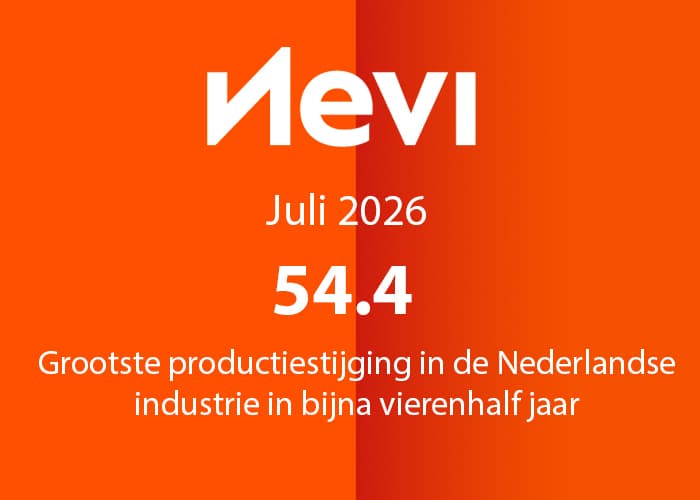
The Dutch manufacturing sector is showing its clearest sign of recovery in years: the Nevi PMI climbed to 54.4, signalling the strongest production growth in over four years. For the fourteenth consecutive month the headline index stayed above the critical 50.0 threshold that separates growth from contraction. Behind that figure lies a story that reaches beyond a single monthly report: a structural shift in demand, driven by the global wave of investment in data centers for artificial intelligence.
What the Nevi PMI reading of 54.4 really tells us
The Purchasing Managers' Index (PMI) is a forward-looking gauge that measures sentiment and activity among industrial buyers. A value well above 50 does not just mean things are improving; it means the acceleration is felt broadly — in production volumes, new orders and factory utilisation. That the index now shows its highest output component in four years is notable, because Dutch and European industry has recently been wrestling with:
- high energy costs that squeeze energy-intensive processes;
- cooled export demand from key trading partners;
- inventory corrections following the post-pandemic peak.
The fact that the tide is turning suggests a new source of demand strong enough to overcome that headwind.
AI data centers driving industrial demand
The most cited explanation for the upturn is the explosive investment in data centers for AI applications. This construction wave ripples through nearly every layer of the supply chain. Data centers require cooling installations, power supply, switch and distribution cabinets, enclosures, cable trays and structural steel. Many of these components are made using classic metalworking: laser and plasma cutting, bending and folding, and metal construction and steel building. Demand for semi-finished products in metals and sheet material rises accordingly.
Crucially, this demand is not purely cyclical. AI infrastructure is seen as a multi-year investment cycle, comparable to earlier waves around mobile internet and cloud computing. That gives suppliers more confidence to invest in capacity, staff and robotics and automation.
Opportunities and risks for manufacturers
The flip side of strong growth is an old pain point: capacity and labour shortages. When order books fill up, lead times lengthen and prices for raw materials and parts climb. Companies able to deliver now gain market share; those held back by staff or machine capacity lose revenue. A few concrete considerations:
- Procurement strategy: locking in contracts for critical materials early limits the risk of rising prices and shortages.
- Automation: investing in robot welding and unmanned production reduces dependence on scarce technical staff.
- Digitalisation: with MES and production software and machine vision and industrial AI, throughput and quality control can be significantly improved.
For precision and high-tech suppliers, the data center boom is also felt indirectly: chip-making machines, cooling systems and energy infrastructure require precision parts from CNC milling and CNC turning.
Sustainability and energy as a decisive factor
The rise of AI data centers also exposes the energy question. These facilities are extremely power-intensive and put grid capacity and sustainability goals under pressure. This creates a dual task for manufacturing: profiting from the demand while helping to develop more efficient cooling, heat recovery and smart energy systems. Companies offering energy-efficiency solutions position themselves in a market that will only grow in the coming years.
What this means for the manufacturing industry
The strong Nevi PMI is more than a favourable monthly number; it marks a shift in which targeted technological investment — especially around AI and data centers — is reigniting industrial demand. For Dutch and European manufacturers the message is twofold: the momentum is there, but capturing it requires timely investment in capacity, automation and smart procurement. Those making decisions now about expansion and digitalisation will determine their position for the years ahead. Companies looking to tap into growing demand can request quotes from specialised suppliers and strengthen their supply chain.