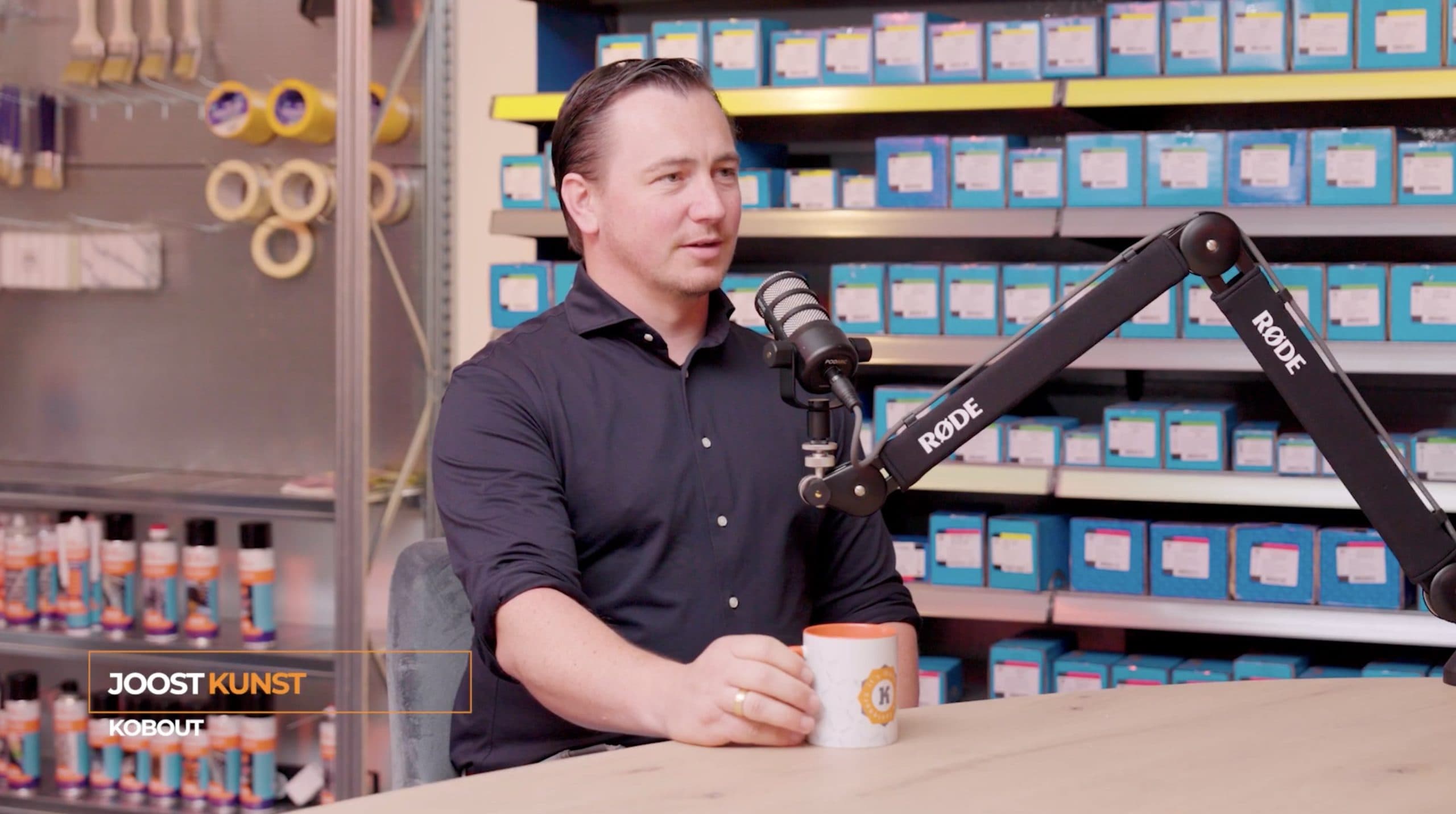
In the manufacturing industry, prices are negotiated fiercely. Down to the penny. Yet meanwhile, euros — and sometimes hundreds of thousands — disappear from organisations every day through costs that never appear explicitly on any invoice. In the latest episode of the video podcast by deindustrie.online, Joost van Kobout joins to expose exactly that: the hidden costs surrounding fasteners, logistics and supply chain processes.
What makes this conversation compelling is that it isn't about theory or consultancy jargon. It's about practice. About boxes that tear. About bolts that are just missing. About production lines that grind to a halt because of something everyone dismisses as a 'side issue'.
The biggest cost isn't the price of the product
When companies look at cost control, the focus is almost always on purchasing prices. But according to Joost, that's precisely the wrong place to optimise.
The biggest hidden costs actually lie in everything around it:
- Packaging
- Delivery reliability
- Internal handling
- Rework
- Lost time on the shop floor
A poorly chosen box, for instance made from cheap imported cardboard, can fall apart the moment it's moved. Parts get lost, have to be recounted or even thrown away. That costs time, attention and money. Yet all of this can be completely prevented with a minimal investment in decent packaging.
Small parts, big consequences
Fasteners are often seen as C-parts: cheap, standard and easily replaceable. But that's exactly what makes them dangerous.
When an incorrect or incomplete delivery arrives, immediate problems arise:
- Products can't be assembled
- Fitters have to improvise with alternative bolts
- Engineering specifications get abandoned
- The quality of the end product declines
In the worst case, an entire production line comes to a standstill. And then the damage is impossible to gauge.
Downtime is the most expensive cost there is
During the conversation, Joost draws an important distinction between two types of customers:
- Project-driven organisations, where timing is crucial
- Companies with continuously running production lines
For that second group, a single missing component is enough to bring everything to a halt. Sometimes it's solved by sending someone to "quickly" pop out to a hardware store. But even if that works, the line is standing still in the meantime. And every minute of downtime costs money.
These are costs rarely attributed to fasteners, yet they are directly caused by them.
Delivery reliability as an absolute prerequisite
At Kobout, delivery reliability isn't a marketing promise but a hard performance indicator. Orders only leave the warehouse once they're complete and correct. Rush orders are visually flagged and given absolute priority.
The result: 99.3 percent of orders are delivered on time, complete and with the right product.
That precision is no coincidence. It's the result of years of investment in digitalisation, automation and process control.
Fewer handling steps means fewer errors
A recurring theme in the conversation is that errors almost always arise from manual steps. That's why, over the past ten years, Kobout has digitalised virtually all its processes:
- Order processing
- Inventory management
- Picking
- Delivery
- Monitoring via dashboards
By making everything measurable, improvement becomes possible too. After all, what isn't measured can't be managed.
The underestimated cost of 'just fixing it'
An incorrect delivery seems minor, but the impact is significant. Internally it means extra work: picking again, repackaging, reshipping. Sometimes even a rush trip across the country to keep a promise.
Internal calculations show that resolving a single mis-delivery quickly costs tens of euros per order line. And that's before factoring in the pressure from the customer, the stress within the organisation and the disruption to planning.
Smart packaging structurally saves time
A striking but logical point in the conversation concerns packaging. Kobout works with standardised, robust boxes that:
- Are easy to open and close
- Remain reusable until the product runs out
- Are clearly labelled with colour codes
- Withstand conditions in production halls
That may seem like a detail, but it means employees work faster, make fewer mistakes and don't have to go searching. Small optimisations, big effect.
Manual sorting is a silent time-waster
In many factories, fitters lose time every day gathering and sorting components. Counting quantities, searching for materials, walking back and forth between the warehouse and workstation.
Kobout tackles this with kitting. Customers supply a parts list, after which complete sets are assembled and packaged per workpiece. Exactly the right quantities, clearly labelled, ready to use immediately.
What takes the customer a great deal of time is done here faster, more consistently and error-free.
Inventory management without guesswork
At Kobout, stock levels are set based on usage, parameters and agreements with customers. If a product drops below a critical threshold, it's automatically reordered. If something is temporarily unavailable, alternatives are actively sought across Europe to prevent downtime.
Delivery reliability is thereby maintained, even when international supply chains are under pressure.
Cutting to size prevents failure costs in assembly
Many threaded rods are supplied in standard lengths, while they are almost always needed cut to size. When fitters do this themselves, risks arise: burrs, untreated metal and quality loss.
By cutting threaded rods to size in advance, deburring and treating them, Kobout delivers a ready-to-use product. Demand for this service is so high that the machine fleet has grown from a single saw to more than ten in twelve years.
Ordering without noise via the portal
Through the digital customer portal, customers gain immediate insight into:
- Available stock
- Agreed prices
- Technical documentation
- Ordering options, optionally linked to their own ERP
Ordered before 3:00 pm means, in practice: delivered the next day. Less email traffic, fewer errors, less dependence on manual communication.
Making hidden costs visible
Not everything has to be based on gut feeling. Kobout helps customers make processes transparent and calculate them through. Together with finance, HR and supply chain, they examine:
- Where time is lost
- Where errors arise
- Which steps are redundant
Often it turns out that seconds per action, multiplied across thousands of repetitions, lead to enormous cost items. But also to major savings, once they're addressed.
The most important step: starting the conversation
According to Joost, the biggest quick win is remarkably simple: starting the conversation. Not from products, but from processes. Not from price, but from impact.
Anyone willing to take a critical look at the 'small' components in the chain will quickly discover where the real money is being lost — and how to prevent that structurally.