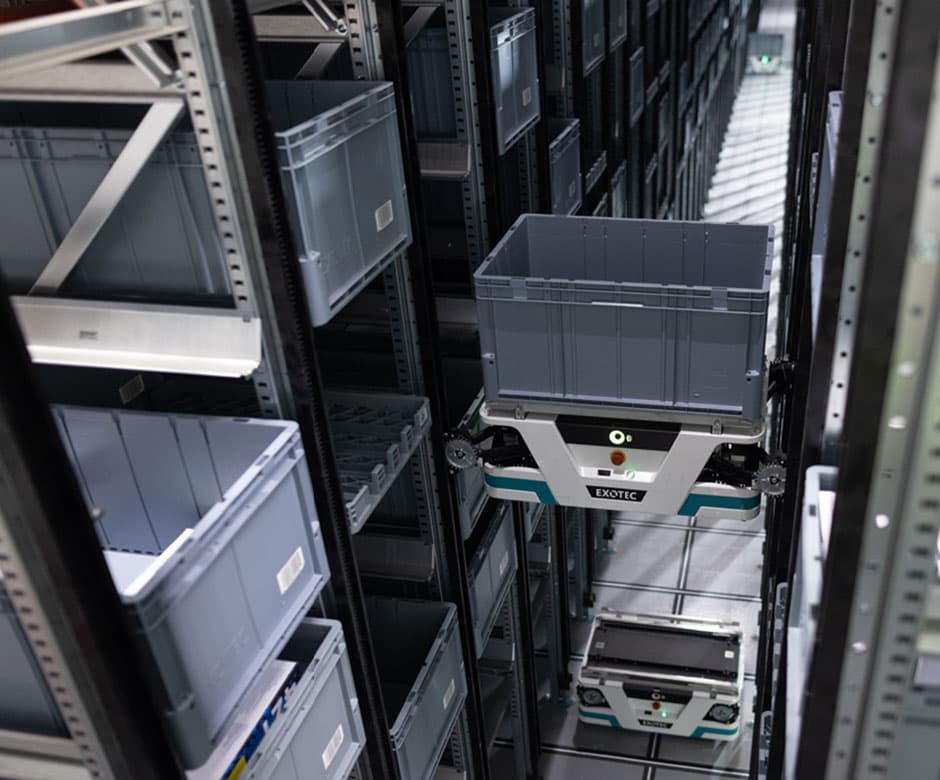
Smart warehouse automation can cut CO2 emissions by up to 25% — provided the technology is used to shrink the physical footprint rather than simply to store more volume. For production and logistics managers in manufacturing, that distinction matters: the same robots, cranes and software systems can produce either a greener or a more energy-hungry operation, depending on how the design is approached.
Why building compact and tall is the key
Traditional warehouses are laid out horizontally: large floor areas, wide aisles for forklifts and relatively low racking. That consumes land, heating, lighting and movement. Automated storage systems — such as shuttle and crane systems or goods-to-person solutions — can stack goods far more densely and to great heights. This sharply reduces the floor area needed per stored unit.
The environmental gain rests on three mechanisms:
- Less heated and lit volume: a more compact building uses less energy for climate control and lighting.
- Lower land use: high-rise storage limits the built footprint and spares ground that would otherwise be paved over.
- More efficient movement: automated systems travel shorter, optimised routes, often electrically, without the dead kilometres of manual handling.
The critical condition: if that same automation is used purely to store more on the same footprint, the gain evaporates. Energy use then grows in step with capacity. The CO2 reduction only materialises when densification is an explicit design goal.
What automation makes technically possible
The savings rely on a chain of technologies that must work together. Robotics and automation form the physical heart: shuttles, lifts and robotic arms that operate without wide aisles and without human intervention. Around them, control intelligence is essential. A well-configured warehouse or production software system decides where each item is best placed, minimises movement and avoids peak loads.
Data makes the difference between theory and practice. Through Industrial IoT and connectivity, energy use, throughput times and occupancy are measured continuously. That reveals whether a system truly runs more efficiently or just faster. This measurability is also essential to demonstrate sustainability to customers, auditors and regulators.
What this means for European manufacturers
For manufacturing in Europe, this is more than a logistics detail. Space is scarce and costly, energy prices remain volatile, and CO2 reporting obligations are tightening. Companies that densify their internal industrial logistics and fulfilment hit several targets at once: lower energy costs, less land use and a stronger sustainability profile.
Even so, the business case is nuanced. A few trade-offs to weigh upfront:
- Investment versus payback: automated high-rise storage requires major capital and a longer depreciation period. Energy and space gains must be calculated over several years.
- Flexibility: highly densified systems are harder to adapt to rapidly shifting product mixes or volume peaks.
- Embodied carbon: steel structures and installations carry their own CO2 footprint. The operational gain must clearly outweigh that initial emission.
- Integration: automation only pays off when it connects seamlessly to existing ERP and production processes.
From capacity thinking to footprint thinking
The core message is a mental shift. For decades, the default question in warehouse automation was: how much more can we store and handle? The sustainability agenda adds a second question: how much less space and energy can we use for the same output? Combine both questions and you extract the maximum return from an investment.
For manufacturers considering automation, it pays to set explicit CO2 and floor-area targets early in the design process, alongside capacity targets. That keeps sustainability from being a by-product and turns it into a managed outcome. In an era of expensive square metres, rising energy costs and tightening regulation, smart automation is therefore not only an efficiency choice but a strategic one — cutting operating costs and climate impact at the same time.