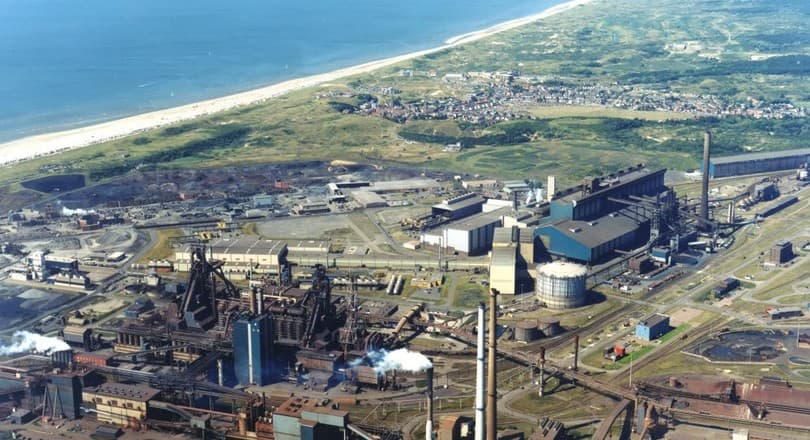
Today, advisers Hans Wijers and Frans Blom of Denkwerk present their recommendations on the future of Tata Steel Nederland. Last October, the Minister of Economic Affairs and Climate Policy, Micky Adriaansens, asked them to explore alternative options for the future of Tata Steel.
The minister's aim is to be able to make a well-considered decision within the framework of the tailor-made agreements with Tata Steel. All stakeholders are looking forward to this advisory report with great interest. Tata Steel is known as the largest CO2 emitter in the Netherlands and has had a significant impact on the region for 106 years, in both good and bad times. But there is also potential for it to become the largest green transformer in the Netherlands.
Green Steel and Coke and Gas Plant II In September 2021, Tata Steel, in cooperation with its parent company, made a definitive choice for the hydrogen route after earlier plans, such as the FNV's Green Steel plan. A report by the international strategic consultancy Ronald Berger concluded that the hydrogen route is technically feasible. In July 2022, principles for greening were formulated between the Ministry of Infrastructure and Water Management (and the environment), the Ministry of Economic Affairs and Climate Policy, the Province of Noord-Holland, Tata Steel Nederland and Tata Steel India. This ‘Expression of Principles’ addresses the major challenges in the area of CO2 reduction and the impact on the environment. Since then, the government has been in talks with Tata Steel about the sustainability process and possible government support.
The report also states that Tata Steel Nederland will conduct research into improving the environmental and health situation before the transition in 2030. This could include ceasing operations such as Coke and Gas Plant II earlier.
Health Effect Assessment In October 2023, State Secretary Vivianne Heijnen of the Ministry of Infrastructure and Water Management established the ‘Expert Group Health IJmond’ under the leadership of Professor Marcel Levi. This expert group advises on all environmental and health aspects that are relevant to the health and living environment in the IJmond area. The expert group recently issued its advice, in which it indicates that the health of residents living near Tata Steel may come under further pressure in the coming years. This is because the sustainability plans include a transition phase between 2025 and 2030, during which new installations are built and tested while old installations remain in operation.
One option being considered by the expert group is to close Coke and Gas Plant II much earlier, possibly in phases. The closure of this plant is currently scheduled for mid-2029. According to the expert group, the plant poses a real health risk, partly due to the emission of carcinogenic substances and its proximity to residential areas. The advice is to systematically take health into account in the considerations regarding permit issuance to Tata Steel and the tailor-made agreements. It is therefore proposed that, alongside the Environmental Impact Assessment, an integrated Health Effect Assessment also be drawn up. The expert group also advises that the government should not grant billions in subsidies to Tata Steel without guarantees for public health.
It would be strange if advisers Wijers and Blom did not incorporate the findings of the Expert Group Health IJmond into their alternative scenarios. An earlier Denkwerk report, ‘Nederland in beweging’, notes that steel production entails considerable external costs in terms of emissions and health risks. Denkwerk, co-founded by Wijers and Blom, advocates reducing or radically making these activities more sustainable.
France and Germany protect their steel industry There is no time to lose. France and Germany have already received the green light from the European Commission to make their steel plants more sustainable with billions of euros in support. Decisions on public support have also already been taken in Spain and Belgium. These countries have a stronger tradition of industrial policy, and their companies and sectors are protected. The Netherlands risks lagging behind. This is despite the fact that we do not want to be dependent on Chinese and Russian steel.
Meanwhile, the owners of the large steel companies are openly trying to secure as much state aid as possible. The CEO of steel giant Arcelor Mittal stated in an interview that the current support packages are insufficient to finance the transition to Green Steel. The CEO of Tata has not yet expressed such a clear position. But in the meantime, Tata has announced significant reorganisations in Port Talbot (United Kingdom), without consulting staff and trade unions. The workers rightly feel betrayed by their Indian owner and the government.
The FNV and Zeester It is right that the FNV is calling on the government to take concrete steps in making the steel plant more sustainable. However, focusing solely on the government is too limited, as Tata Steel shows little decisiveness and appears to be waiting for billions in subsidies with minimal conditions. It remains unclear what contribution Tata itself is making to the multi-billion euro greening of the steel plant in IJmuiden. Preserving high-quality steel production is of great importance. However, the management of Tata Steel Nederland repeatedly maintains that employees must be laid off, without strong justification. Employees must urge management to accelerate sustainability efforts, which will lead to sustainable jobs.
The Zeester Foundation, made up of former directors, professors, trade union officials and other experts, has long advocated for a shareholder for the steel plant that has a strategic interest in Europe. The government could support this process by taking a temporary stake during the company's difficult transition period. This could increase confidence that the sustainability transition will be successful. Zeester also advocates for a new industrial cluster with synergies with the steel company, in order to increase the chances of economic success for the region and the company. The steel plant is so strategically important to our society, but to obtain a new ‘license to operate’, the corporate governance surrounding the company must also be adjusted to serve the interests of all key stakeholders.