Introduction
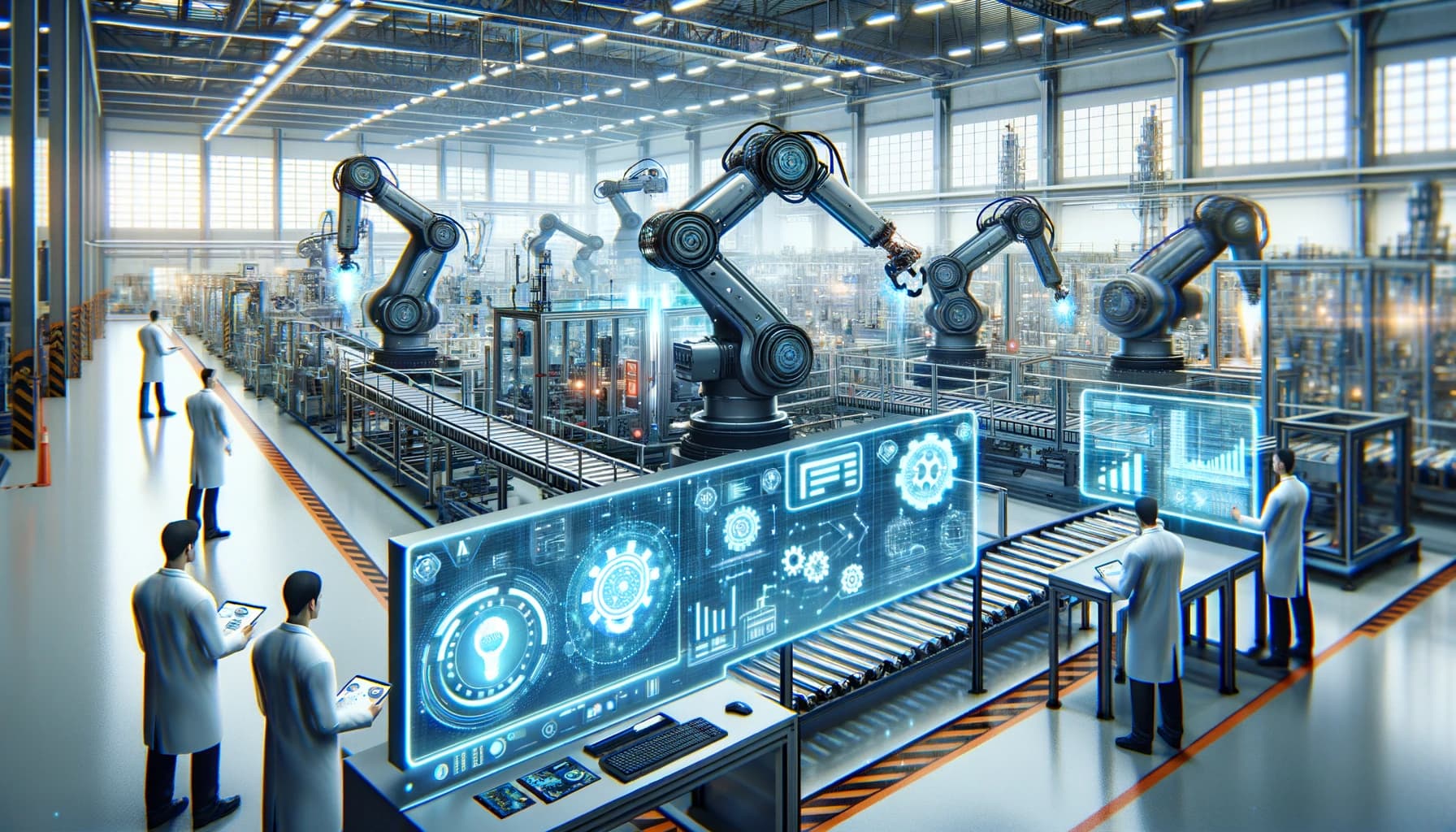
In 2024, the manufacturing industry is undergoing significant changes worldwide. Innovations and technological advances, particularly in the field of artificial intelligence (AI), are playing a crucial role in this transformation. This article explores the evolution of the manufacturing industry, the role of AI and the impact of these technologies on the future of production processes.
The evolution of the manufacturing industry
Historical context
The manufacturing industry has a long history of innovation and adaptation. From the first industrial revolution, characterised by mechanisation, to the digital revolution of the late 20th century, the sector has continuously embraced new technologies to improve production processes and make them more efficient.
Digital transformation
Over the past few decades, digital transformation has radically changed the way products are designed, manufactured and distributed. The integration of digital technologies such as computer-aided design (CAD), computer-aided manufacturing (CAM) and enterprise resource planning (ERP) systems has led to significant efficiency gains.
Smart manufacturing
The rise of the Internet of Things (IoT) and cyber-physical systems has paved the way for smart manufacturing. In smart factories, machines and systems are interconnected and communicate in real time to optimise and monitor production processes. This has led to improved flexibility, higher production quality and lower costs.
The role of AI in the manufacturing industry
What is AI and how does it work?
AI, or artificial intelligence, refers to the simulation of human intelligence in machines that are programmed to think like humans and mimic their actions. AI systems can learn from experience, recognise patterns and make decisions based on data.
AI and machine learning
Machine learning (ML) is a subset of AI that enables machines to learn from data without being explicitly programmed. By using algorithms and statistical models, ML systems can identify patterns and make predictions. This is particularly useful in the manufacturing industry, where large amounts of data are generated.
Benefits of AI in production
AI offers numerous benefits for the manufacturing industry, including:
- Increased efficiency: AI systems can optimise production processes by identifying and eliminating bottlenecks.
- Better quality: Through continuous monitoring and analysis, AI systems can quickly detect and correct quality issues.
- Cost savings: Through predictive maintenance and more efficient production planning, companies can reduce costs.
- Flexibility: AI makes it possible to respond quickly to changes in demand and production requirements.
AI applications in the manufacturing industry
Predictive maintenance
Predictive maintenance uses AI and IoT sensors to monitor the condition of machines and predict maintenance before failures occur. This reduces unplanned downtime and maintenance costs.
Quality control
AI-based quality control systems use computer vision and machine learning to inspect products during the production process and detect deviations. This improves product quality and reduces waste.
Demand forecasting
AI helps companies forecast product demand by analysing historical data and market trends. This leads to better inventory management and production planning, enabling companies to operate more efficiently.
Supply chain optimisation
AI plays a crucial role in supply chain optimisation. Through data analysis, companies can better manage their supply chain, reduce costs and improve delivery times.
Process automation
AI and robotics are increasingly being integrated into production processes to automate tasks previously performed by humans. This increases production speed and reduces the likelihood of human error.
Case studies of AI implementation
Examples of successful AI implementations
There are numerous examples of companies that have successfully implemented AI in their production processes. For example:
- Siemens: Siemens has used AI to optimise their production lines and increase efficiency. This has led to significant cost savings and improved product quality.
- GE Aviation: GE Aviation uses AI for predictive maintenance of their aircraft engines, which has resulted in less downtime and lower maintenance costs.
Lessons learned from case studies
From these case studies, we can draw several lessons:
- Small steps: Start with small-scale AI projects and scale up as you gain more experience and confidence.
- Data is crucial: Ensure access to quality data, as this forms the basis for effective AI applications.
- Collaboration: Work with technology partners and experts to facilitate the implementation of AI.
Challenges and considerations in AI integration
Technological challenges
The integration of AI in the manufacturing industry brings several technological challenges, such as:
- Data integrity: Ensuring the quality and consistency of data is essential for effective AI systems.
- Infrastructure: Companies need to invest in the right infrastructure, such as powerful computers and network connections.
- Security: AI systems must be protected against cyberattacks and data breaches.
Ethical and societal considerations
In addition to technological challenges, there are also ethical and societal considerations, including:
- Privacy: The use of AI raises questions about privacy and data protection.
- Employment: The automation of tasks by AI can lead to job losses, which is a concern for employees and trade unions.
- Transparency: AI decisions must be transparent and understandable in order to maintain the trust of stakeholders.
The future of AI in the manufacturing industry
Emerging technologies
There are several emerging technologies shaping the future of AI in the manufacturing industry, such as:
- Edge computing: Processing data at the edge of the network for faster and more efficient AI applications.
- Quantum computing: Enabling more complex calculations that exceed the capabilities of current AI systems.
The role of data in AI
Data plays a crucial role in the effectiveness of AI systems. As more data becomes available and analysis techniques improve, AI applications in the manufacturing industry will become increasingly powerful and accurate.
Innovations in robotics
Robotics continues to evolve with the integration of AI, leading to more advanced robots that can work autonomously and perform complex tasks. This will further improve production efficiency and open up new possibilities.
Conclusion
The manufacturing industry is undergoing a fundamental transformation, driven by innovations and the integration of AI technologies. AI offers significant benefits, including improved efficiency, better quality control and lower costs. Despite the challenges, the outlook is positive, with emerging technologies that have the potential to further revolutionise the industry. Companies that embrace AI and deploy it strategically will gain a competitive advantage and be better positioned for the future.
Frequently asked questions (FAQs)
What are the benefits of AI in the manufacturing industry? AI offers numerous benefits in the manufacturing industry, such as increased efficiency, improved quality control, cost savings and greater flexibility in production processes.
How does AI affect employment in the manufacturing industry? AI can lead to job losses through the automation of repetitive tasks, but it also creates new jobs in the development, implementation and maintenance of AI systems.
What are the biggest challenges in integrating AI? The biggest challenges are data integrity, technological infrastructure, security, ethical considerations and safeguarding privacy.
How can companies get started with AI in their production processes? Companies can start with small-scale AI projects, invest in data infrastructure, collaborate with technology partners and experts, and train their staff in AI technologies.
What are the future trends in AI for the manufacturing industry? Future trends include the integration of edge computing, quantum computing, and further innovations in robotics and machine learning.
How does AI provide a competitive advantage in the manufacturing industry? AI provides a competitive advantage by optimising production processes, reducing costs, improving product quality and enabling companies to respond quickly to market changes.