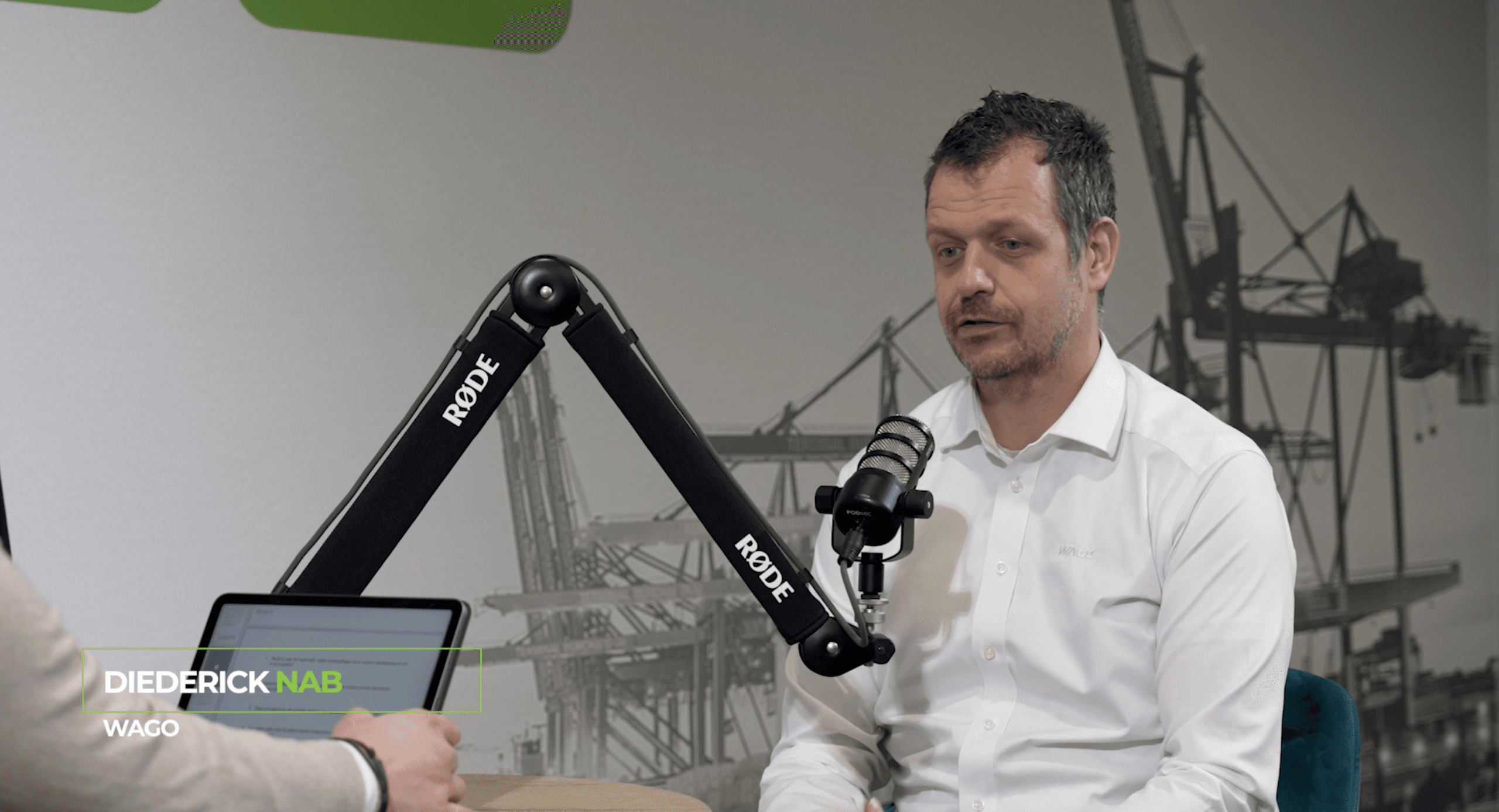
Digitalisation is no longer an unfamiliar word in industry. Everyone is talking about IoT, dashboards, data, smart production and predictive maintenance. Yet many companies remain stuck in the phase between interest and action. According to Diederik of WAGO, this strikingly often happens not because the technology is lacking, but because companies think too big, wait too long, or simply fail to see how much value is already hidden in their existing installations.
That is what makes his account interesting. Because where IoT often still felt like an experiment a few years ago, he now sees a clear shift. The technology has matured enough not only to be tested, but also to deliver targeted value. So the question is less about whether something is possible, and increasingly: why then is so little still happening?
IoT sounds complicated, but actually starts out very simply
According to Diederik, IoT at its core comes down to one thing: extracting data from installations and using that data to better understand what is happening in a process. It is about status information, trends, relationships between different signals and ultimately the ability to produce more intelligently, configure more efficiently and better predict when maintenance is needed.
This turns IoT into something other than a standalone technical gadget — it becomes a way to make installations perform better. For example, by seeing that temperature and energy consumption rise at the same time while production stays the same. That kind of anomaly can signal early on that something is going wrong, before a fault actually becomes visible on the shop floor.
The biggest mistake: wanting to digitalise the entire factory at once
When companies get stuck in digitalisation, the cause according to Diederik often lies in how they begin. Many organisations immediately think about digitalising their entire factory. And it is precisely this that makes the project too large, too heavy and too abstract. His advice is therefore strikingly down to earth: keep it small. Choose one asset, one installation or one recurring problem where something regularly goes wrong, and build a first use case around that.
That, in his view, is the smartest route, because you can then quickly demonstrate value. Not with a mega-project that tries to solve everything at once, but with a scalable first step that shows what data can deliver in practice.
Many companies mainly underestimate how simple the first step is
In addition to thinking too big, Diederik sees a second misconception at play: companies often overestimate the complexity. Of course digitalisation is no child's play, he says, but it is no longer rocket science either. The bridge between OT and IT in particular — once often a hurdle — is nowadays much easier to build with existing hardware and software solutions.
By this he means that operational data from machines or installations can now be brought to an IT environment far more easily, where it can then be made visible and analysed. The first step is therefore no longer as technically insurmountable as many companies think.
You don't have to tear your factory apart
An important point in the conversation is that existing installations do not first have to be fully replaced. According to Diederik, it is actually all about adding a data layer on top of the existing environment. That data layer brings together information from the installations and makes it possible to store it centrally, analyse it and use it for optimisation.
This means digitalisation is often far less disruptive than entrepreneurs fear. So you don't necessarily have to rebuild the entire factory. In many cases PLC data is already available, and it is mainly a matter of unlocking that data intelligently.
Brownfield often holds more value than companies think
One of Diederik's most striking observations is that many brownfield installations already contain data that is barely used. And that, in his view, is precisely where much of the gain is left untapped. Companies sometimes think they first have to build everything new, when in reality they can already carry out very useful analyses with limited datasets.
In other words: the first insights don't have to wait for perfect conditions. Even with a limited set of signals you can already discover patterns, derive status information and find opportunities for improvement.
Old installations are not hopeless, but require a different start
That doesn't mean every installation is equally easy to connect. Diederik does draw a distinction between newer and older systems. With modern installations, a lot of data is often already available and a connection can be made relatively easily. Sometimes a network connection is enough to unlock that data.
With older installations it is different. There, extra instrumentation or sensoring often has to be added first just to collect enough data. As a result, the first step is more demanding there. But even then it doesn't mean digitalisation is impossible — only that step one becomes a bit more extensive.
Standards make digitalisation scalable
Another important factor in the conversation is standardisation. Diederik cites protocols such as MQTT and OPC UA as important tools for better connecting OT and IT. OPC UA in particular, he says, helps make digitalisation more scalable, because it is highly standardised and therefore easier to implement.
MQTT, on the other hand, he describes as more flexible, especially where cloud communication plays a role. The underlying message is clear: standards make it easier to connect systems openly and to make data usable across multiple layers.
The biggest technical hurdle often lies not in IoT, but in cybersecurity
If there is a real hurdle, then Diederik points above all to cybersecurity. As long as data stays within your own environment, the threshold is relatively low, he says. But as soon as information leaves the factory — for example towards the cloud or external platforms — the playing field changes. Then you have to think carefully about security, access and architecture.
That makes cybersecurity not a precondition to be dealt with afterwards, but something that must be part of the digitalisation choices from the very start.
New legislation forces companies to take security more seriously
That urgency is also growing. Diederik explicitly refers to the Cyber Resilience Act, which requires European companies to comply with stricter safety standards. For products this will soon also have direct consequences for CE marking. According to him, WAGO is therefore deliberately moving from Secure by Design to Secure by Default: devices should be securely configured by default, so that users don't have to keep rethinking this themselves every time.
This shows that cybersecurity is no longer an optional theme for IT specialists, but increasingly a basic requirement in industrial digitalisation.
Cyber still seems to many companies like something that happens to 'others'
Strikingly, Diederik also notes that many entrepreneurs still see cybersecurity as something that probably won't happen to them. That attitude is recognisable: as long as an incident remains abstract, it easily fades into the background. WAGO tries to play a different role here as a partner, by not only supplying customers with hardware or software, but also helping to organise business continuity through safer products and software.
A lack of IT knowledge no longer has to be a reason not to start
Another recurring reason for delay is a lack of IT knowledge. Here too Diederik is strikingly practical. In his view, solutions should be designed so intuitively that the threshold becomes lower for industrial users. That is why WAGO, according to him, focuses on plug-and-play software and off-the-shelf commercial solutions that narrow the gap between OT and IT.
That doesn't mean every company can do everything itself, but it does mean the starting point has become far more accessible than a few years ago.
Three areas where digitalisation can deliver immediate benefits
When Diederik sums up the returns of smart digitalisation, he arrives at three classic project pillars: money, time and capacity. In his view, digitalisation lets you manage your installations better, produce more efficiently, plan maintenance more intelligently and deploy your staff more effectively.
That, he says, is what makes IoT valuable above all as a steering instrument. Not because data is interesting in itself, but because you can use it to act on costs, availability and workload.
Energy is now the KPI companies should steer on first
When asked where companies should concretely start tomorrow, Diederik arrives strikingly quickly at one KPI: energy. The reason is clear. Energy prices are uncertain, the electricity grid is congested, and companies often still don't know enough about what installations actually consume and when that consumption rises.
That is precisely why he sees energy as a logical first focus point. Not only because it directly affects costs, but also because energy data is often easy to measure and quickly reveals inefficiency or abnormal behaviour of installations.
The real opportunity lies not in more data, but in smarter use of the data already there
Perhaps the most important message from the conversation is that many companies don't have too little data, but above all do too little with the data already available. And that, according to Diederik, is precisely where much of the gain is left untapped. Those who succeed in intelligently collecting, combining and putting existing signals into context can often make surprisingly quick progress in reliability, maintenance and efficiency.
Conclusion
The story of Diederik makes clear that digitalisation in industry has become less mysterious than many companies still think. The technology is mature, standards help connect OT and IT, and many factories already have more usable data than they themselves realise. The biggest mistake is therefore not that companies can do too little, but that they start too big or wait too long.
According to WAGO, the smartest route lies in starting small, choosing one clear use case and steering on a measurable KPI such as energy. Those who get this right often discover that digitalisation doesn't start with a revolution, but with one targeted step that finally makes visible what has been hidden in the factory all along.
FAQ
What does WAGO mean by IoT in industry?
According to Diederik, IoT is about collecting data from installations, making that data visible and using it to produce more intelligently and maintain better.
Why do many companies still not start with digitalisation?
Because they often think too big, overestimate the complexity, or don't quite know where to begin.
Does an entire factory have to be torn apart to start with IoT?
No. According to WAGO, you can often start with an additional data layer on top of existing installations.
Are older installations harder to digitalise?
Yes, often a bit harder. With older systems, extra sensors sometimes have to be installed to make data visible.
What, according to Diederik, is the most important KPI to start with?
Energy. By making energy consumption visible, companies can, in his view, quickly see where efficiency gains can be made.