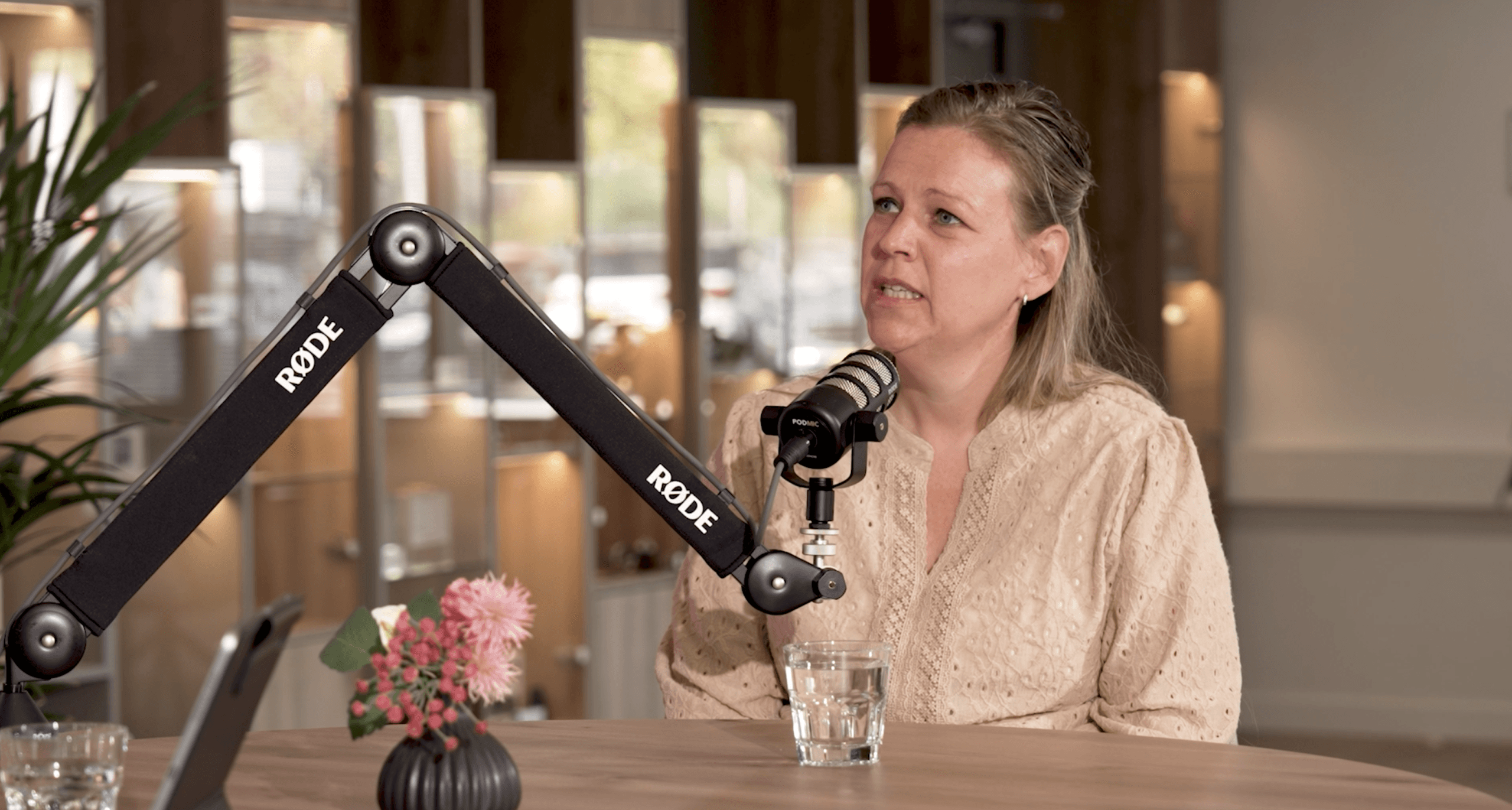
In the plastics world, sustainability is still often reduced to a single question: which material do you use? But for Cristel Rijnen, owner of Injection Point, that view is far too simplistic. Anyone who truly wants to produce more sustainably must look not only at recyclate or bioplastics, but also at energy consumption, product design, assembly, process setup and the way automation is deployed.
That is what makes Injection Point's story interesting. The company does not see sustainability as a separate theme alongside production, but as something that runs through the entire operation. From machine efficiency and green power to customer advice and the question of whether a product can still be disassembled or recycled at the end of its life.
Injection Point makes technical plastic products built to last
According to Rijnen, Injection Point is a technical injection moulding company focused on durable plastic products. By that she emphatically does not mean disposable products, but products with a longer functional lifespan. These range from housings for electrical equipment and components for sun blinds and insect screens to horse bits, components for card payment terminals and accessories for water bottles.
That breadth matters, because it immediately shows what kind of market the company operates in. Not a mass disposable stream, but technical components that are often part of a larger system or product and therefore also impose different requirements on quality, reliability and lifespan.
The sustainability mission started on a personal level
What stands out in the conversation is that Injection Point's sustainability ambition did not begin from legislation or market pressure, but from something personal. Rijnen explains that she became more conscious of material use and waste when she had children herself. The amount of stuff in the house grew, and at the same time she noticed how difficult it was to give a second life to items that were no longer used. Much of it ultimately ended up as waste anyway.
That realisation also gave rise to the desire to do things differently in her company. Not to change the world in one go, but to ensure that Injection Point, within its own sphere of influence, produces more consciously and tries to bring customers along in that.
At Injection Point, sustainability runs throughout the factory
That mission translates not only into product development, but also into the factory itself. Injection Point tries to set up its own processes as green as possible. The company generates its own electricity with solar panels, additionally purchases Dutch wind energy and is almost entirely off gas. The warehouse is also heated using residual heat from production. The machines run on energy-efficient electric motors.
This shows that sustainability here is not seen as a marketing layer on top of the operation, but as something that also has to be reflected in the company's day-to-day functioning.
It's not just your own process that counts, but also the product design
A second important track lies in the development phase of new products. Injection Point tries to make customers aware early on of the choices that influence a product's eventual footprint. This involves questions such as: can recyclate be used here? Does bioplastic make sense? Can the product be dismantled at the end of its life? Can components be separated more easily? Is a redesign needed to make recycling or reuse more feasible?
This shifts the role of the injection moulder from pure manufacturer to a partner who also thinks along about the sustainability of the end product.
The challenge for Dutch injection moulders lies not only in technology, but also in competitiveness
At the same time, Rijnen paints a sober picture of the market. Dutch injection moulding companies have to stay competitive in a country that, in her words, has become an expensive place to do business. Labour costs are high, staff are scarce and foreign production is becoming relatively cheaper.
That makes the playing field difficult. Dutch companies are, in her view, often innovative and intrinsically motivated to take steps towards sustainability, but those efforts ultimately have to remain competitive in a market where price pressure remains high.
For Injection Point, automation is not an end in itself, but a means
Automation plays a clear role in that tension. According to Rijnen, automation is important for capacity, for quality and for financial viability. In a country where hands are both scarce and expensive, running unmanned for longer becomes more attractive. Moreover, injection moulding is a process where repetition is essential, and it is precisely there that systems are often more consistent than people.
Yet the story is more nuanced than simply saying: more automation is always better. Injection Point mainly runs medium-sized batches. That means order sizes are smaller than, for example, in packaging production, where mass production much more quickly produces a business case for far-reaching automation.
This raises a different question: how do you automate in such a way that the automation can serve many different orders and products?
Standardising automation is harder than it seems
Rijnen explains that full automation often becomes simpler the longer you run the same product. Then you can build a complete machine setup that is fully optimised around that one part. At Injection Point it works differently. Orders change more often, quantities are smaller, and as a result it pays off less to build a separate automation solution for each individual product.
That is why Injection Point does not look for maximum automation per product, but for automation that is as all-round as possible and can support a large part of the order portfolio.
Cobots are interesting, but the real bottleneck is often somewhere else
A nice example of that complexity is the way Rijnen looks at cobots. For ten years she has been hearing that cobots would replace the temporary worker. The theory sounds appealing: a flexible robot that takes over standard tasks. But in practice the cobot itself turns out not to be the biggest problem. The challenge often lies in the feeding. Products have to be fed in the right way, and it is precisely that feeding that is often custom made for one specific product.
And that is often where the business case goes wrong. Not because the cobot can't do anything, but because everything around it becomes too product-specific and therefore too expensive.
Which problem are you actually solving?
That is perhaps the most important thread in her story about automation. Every investment starts with the same question: which problem do we actually want to solve? Only once that is clear can you determine whether automation is the right route. Injection Point takes a pragmatic look at bottlenecks, volumes, error rates and the question of whether a solution is broadly enough deployable to become profitable.
That makes the approach very operational. Not automating because it can be done, but because it demonstrably improves something.
Automating too far can defeat the purpose
In the conversation, Rijnen gives a concrete example of a project in which they looked at whether not only the injection moulding but also the assembly of a product could be automated directly in line behind the machine. Technically, a lot was possible. But to make it work, trays had to be filled, a person had to feed those trays, and the investment became substantial. Moreover, the risk grew that a single fault in the chain would bring the entire line to a standstill.
The conclusion was therefore clear: you have to be careful that automation not only looks impressive, but also remains genuinely sensible in practice. Sometimes a separate post-production step is smarter than trying to squeeze everything into one line.
Automation can pay off precisely for SMEs
At the same time, Rijnen emphasises that automation is not only relevant for large companies or mass production. Smaller SME players can also benefit from it, as long as they look carefully at where they automate and why. In her view, an enormous amount is already possible, but you have to avoid going too far without the investment still being in proportion to the problem.
That is an important message, especially for medium-sized manufacturers who often think that automation only becomes interesting at high volumes.
Smart solutions don't have to be expensive
One of the finest examples from the conversation shows that automation does not always have to consist of multi-million projects. Injection Point had a combination mould in which four unique articles were produced simultaneously. The machine had too little technology to remove those four products separately as standard. So an in-house solution was devised in which one product was dropped, three products travelled along a belt, and a simple homemade system with blown air pushed a third product aside into a separate box. In this way all four parts were automatically discharged separately, without any risk of mixing them up.
That is exactly the kind of pragmatic automation Rijnen aims for: fault-free, effective, affordable and cleverly devised in-house.
Sustainability also requires measurement, not just assumptions
Alongside automation, energy efficiency also plays a major role. Here Rijnen emphasises that you sometimes only discover what is truly sustainable by measuring. That is why Injection Point started years ago with sensors that read out machines' consumption data. Initially this began as a pilot with a start-up, but by now the company has built up seven years of measurement data.
That data makes it possible not only to make assumptions, but to actually see the effect of design choices on energy consumption.
Less material is not always more sustainable
That is also apparent from a striking example that Rijnen mentions. In advisory conversations, Injection Point uses, among other things, the 5 R's, including reduce. Using less material then seems automatically better. But in one concrete case it turned out that a product had been made so thin-walled that the machine needed more energy to still produce it properly. Because of the higher pressure and the internal stresses, electricity consumption rose. In that case, "reduce" actually turned out to be less favourable for the footprint.
That is a powerful insight: sustainability is not a standard recipe. You have to look, project by project, at what works out better in the end.
Injection Point looks for partners who think along, not just want to sell
There is also a clear line in the choice of automation and energy partners. Rijnen says explicitly that she looks for partners who think along pragmatically about what is interesting for Injection Point, and not for parties who mainly want to sell their most expensive systems.
She illustrates this with an example from years ago, when she was looking for a mobile robot that could be deployed between different machines. Such a flexible solution did not exist then, or at least was not being developed, because suppliers had more interest in selling several fixed robots than one flexible system.
That example says a lot about her way of looking at things: it's not only the technical question that counts, but also the mindset of the partner at the table.
Strategy or necessity: automation can happen in two ways
At the end of the conversation, Rijnen makes another interesting distinction between automating from strategy and automating from necessity. Strategic automation requires investing ahead and taking a risk based on a vision. Automating from necessity means you solve a concrete problem as soon as it arises.
Both routes have their logic. Investing strategically can work out cheaper in the longer term, because you solve several future problems at once. But it does require capital and nerve. Only solving problems as they arise spreads out the investments, but often leads to higher costs in the long run. That tension, according to Rijnen, is recognisable to many entrepreneurs, certainly in economically uncertain times.
The most important lesson: start small, but do start
If there is one common thread running through the conversation, it is this: you simply have to start. Don't wait until the perfect plan is ready, but start small with something that is manageable for the organisation and the wallet. According to Rijnen, Injection Point also did not make its development in one big step, but through one small improvement after another.
And it is precisely when you look back later that you see how much those small steps have delivered together. That makes Injection Point's story convincing: sustainability and automation do not have to be a big one-off programme. They can also simply start with one smart adjustment, one measurement project or one practical improvement on the shop floor.
Conclusion
Injection Point shows that sustainable production in plastics does not revolve around one miracle solution. It is about a series of trade-offs: material use, energy consumption, automation, product design and process logic. According to Cristel Rijnen, the gain lies precisely in daring to keep looking anew at where things can be smarter, lighter, more energy-efficient or more practical.
In that context, automation is not an end in itself, but a means that only has value if it genuinely solves a problem. And sustainability is not a slogan, but something you have to measure, test and sometimes even relearn how to understand. It is precisely that pragmatic combination that makes Injection Point's story relevant for many more companies than just those in the injection moulding sector.
FAQ
What does Injection Point do?
Injection Point is a technical injection moulding company that makes durable plastic products, such as housings, components for sun blinds, horse bits and components for water bottles and card payment terminals.
Why is sustainability so important to Injection Point?
Because the company sees sustainability as part of its mission, both in its own factory and in the development of products for customers.
Does automation play a role in becoming more sustainable?
Yes. According to Injection Point, automation helps with capacity, quality and more efficient production, but only if that automation is also genuinely sensible and profitable.
Why is automation more difficult for medium-sized batches?
Because orders change more often, so the business case for product-specific automation is less quickly achieved than in mass production.
What, according to Injection Point, is the most important lesson?
Start small, keep it manageable and keep improving step by step. Big changes often arise from a series of small choices.