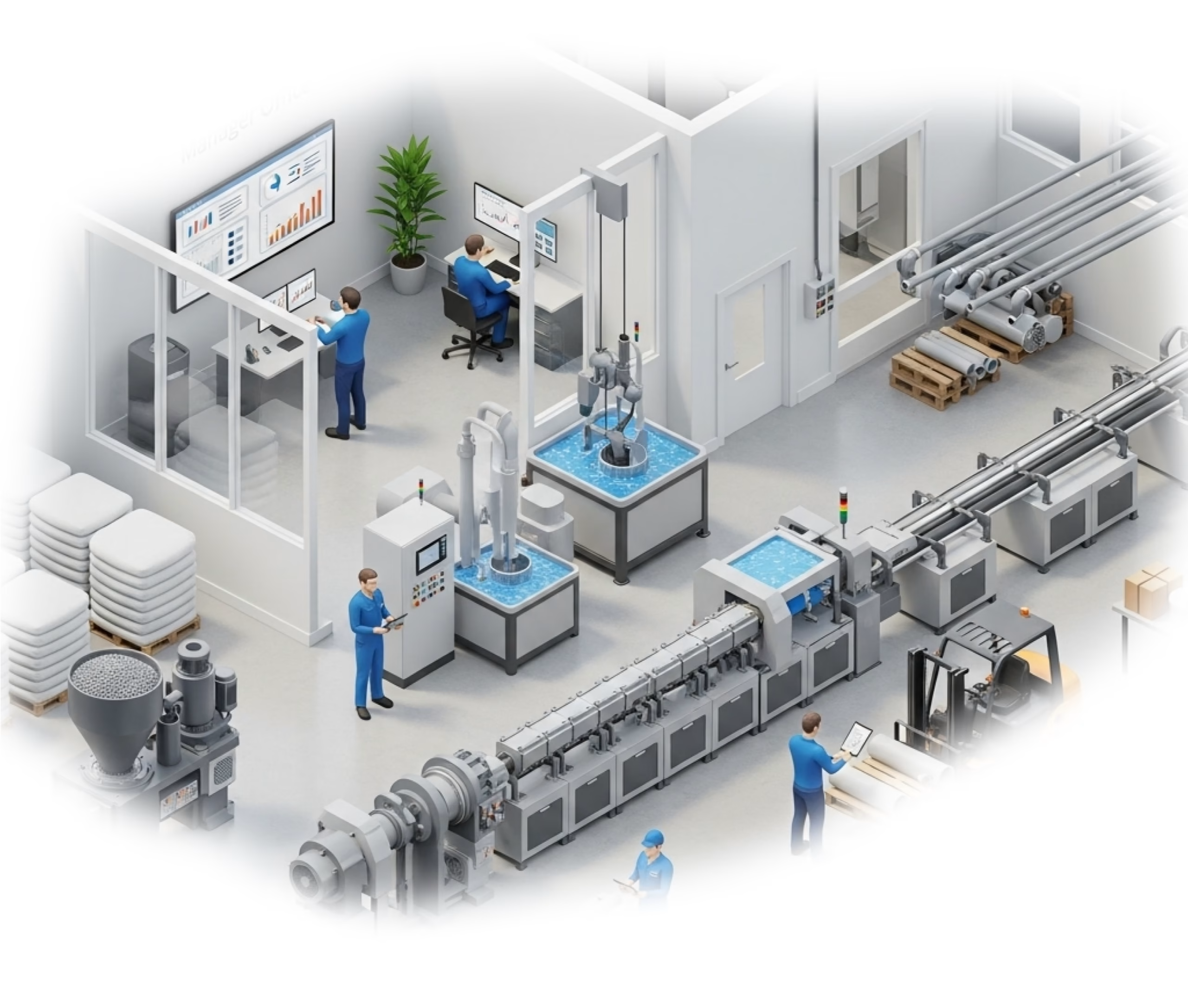
The manufacturing industry is at a tipping point. Rising energy prices, globalisation and the outflow of experienced skilled workers are forcing production companies to work smarter and more efficiently. According to Floris Wyers, founder of Oppr.AI, the key lies in a digital operator that combines human knowledge with machine data.
In the video podcast De Industrie Online, Wyers explains how his solution reduces downtime, improves quality and safeguards knowledge that would otherwise be lost. "AI is most valuable where it supports people, not replaces them. Anyone who still hasn't started will soon fall irreparably behind."
Why the manufacturing industry is data-rich but insight-poor
Anyone walking into a factory today sees data everywhere: dashboards, Excel files, forms, sensors. Yet much of this information remains unused.
"The reality is that many companies are data-rich but insight-poor," says Wyers. "Information is scattered across departments and systems. Operators see things, hear anomalies or smell something odd, but that context never makes it into the database. As a result, crucial connections are never made."
The result? Decisions are made on gut feeling or purely on the basis of machine data, whereas it is precisely the combination with human observations that leads to better insight.
The digital operator: human + machine + AI
With Oppr AI, Wyers developed a digital operator that connects three worlds:
- Machine data – sensors record vibrations, temperatures and process values.
- Human knowledge – operators detect anomalies in smell, colour, sound and vibration.
- AI – structures all this information, links it over time and makes patterns visible.
"The machine tells you what is happening, the human knows why. By bringing both perspectives together, you get a complete picture that was previously invisible," says Wyers.
Operators can capture information multimodally: via text, speech or photos. AI automatically converts these varied inputs into a standardised format. In this way, dozens of subjective reports become one unambiguous truth.
From months-long project to minutes: real-time optimisation
Traditionally, process optimisation often runs on long cycles: a problem is identified, analysis follows, a solution is implemented, and only after weeks or months do results appear.
"With real-time data and context, you can carry out micro-optimisations within minutes instead of months," says Wyers.
Examples from practice
- Unplanned downtime: AI links operator notes (e.g. 'valve is stiff') directly to machine data. Causes are identified more quickly.
- Quality fluctuations: deviations in colour or smell that operators notice are added to the dataset. Over time it becomes apparent, for example, that a particular cleaning action has a direct effect on quality deviations.
- Continuous improvement: small adjustments are implemented daily, without large projects carrying high failure costs.
"You avoid expensive big-bang initiatives. It is precisely through small, quick improvements that you build a structural competitive advantage," Wyers emphasises.
Downtime: the silent killer of productivity
Unplanned downtime is the biggest cost item for many production companies. According to Wyers, the cause often lies in creeping issues that sensors do not measure: material build-up, contamination, minute deviations in machine behaviour.
"If operators capture these signals during their rounds — and AI places them alongside the sensor data — you can address causes much earlier. You eliminate small risks before they cause major breakdowns."
The result: less unplanned downtime, higher uptime and lower maintenance costs.
Quality: more than a final measurement
In many factories, quality is only measured at the end of the line. That is too late, argues Wyers.
"Quality is rarely a single moment. It is the sum of all steps in the process. If deviations along the way are not recorded, you lose crucial information. By incorporating operator context immediately, quality becomes more predictable and first-time-right much higher."
Examples:
- An operator notices that a liquid looks greener than usual.
- A machine produces an unusual sound with a specific batch.
- A cleaning session turns out to have a direct impact on the next run.
With AI, all of this is recorded and linked, making correlations visible and enabling quality loss to be prevented.
Safeguarding tribal knowledge before the skilled workers disappear
The outflow of experienced operators is an urgent problem. Many skilled workers carry decades of knowledge in their heads that has never been documented.
Wyers illustrates this with a case: "We had an operator, let's call him Piet, who was about to retire after thirty years. Instead of asking him to fill in twenty Word files, we shadowed him for weeks. Everything he did was recorded: speech, photos, observations. AI turned that into a searchable knowledge base. That way his experience remains available for the next generation."
New operators effectively receive private lessons from their predecessor, supported by an intuitive AI platform. For companies, this means crucial know-how is not lost but becomes a structural part of the production process.
When is a factory ready for a digital operator?
Not every company can start tomorrow. According to Wyers, there are clear prerequisites:
- Basic data in place: there is already machine data or standard procedures/checklists.
- Digital mindset: willingness to centralise and standardise.
- Data quality: input must be reliable; manual errors must be minimised.
- Internal buy-in: operators must see the value and find the system intuitive.
"If you're starting completely from scratch, a transformation is often still needed. But anyone already collecting and digitalising data can take immediate steps and see results within a pilot."
Common mistakes in digitalisation
- Island automation – departments optimise in isolation, leaving no integrated overview.
- Fragmented storage – information in Excel, loose forms or shadow IT, without a single central truth.
- Inconsistent input – errors in manual recording, missing fields or sloppy notes.
The solution? A digital foundation: one central storage, standardised forms and clear data definitions. "Only when your data is reliable and consistent can you truly benefit from AI," says Wyers.
What a pilot with Oppr AI looks like
An engagement always starts with a pilot of 3–6 months.
- Introduction & scope – define the objective (e.g. reduce downtime, increase OEE).
- Historical data analysis – Oppr AI analyses existing data and validates hypotheses.
- Proposal & KPIs – concrete plan with measurement points.
- Rollout & coaching – operators record intuitively via speech, text and photo.
- Evaluation & scaling – micro-optimisations are implemented structurally.
Companies often see results within the pilot itself: less downtime, faster decision-making and higher first-time-right.
The business case: why now?
According to Wyers, the urgency is crystal clear:
- Costs: energy and raw material prices are rising; margins are under pressure.
- Competition: globalisation and Chinese price pressure make efficiency crucial.
- Talent: the outflow of experienced operators calls for knowledge safeguarding.
- Technology: AI is now mature enough to also support the physical shop floor.
"Anyone investing in a digital operator now is building a sustainable competitive advantage. Waiting means falling behind in ways you can no longer make up for."
Frequently asked questions (FAQ)
Will AI replace our people?
No. The digital operator is intended to support operators and safeguard their knowledge, not to replace them.
Do we need expensive new sensors?
Not necessarily. Start with what you have and enrich it with context from operators via speech, text and photo.
What if our data is messy?
Start by laying a digital foundation: centralise, standardise and improve data quality.
When will we see results?
In many cases, already within the pilot, through small improvements that have a direct impact on uptime and quality.
Want to know more?
Curious whether your factory is leaving money on the table?
Get in touch with Floris Wyers of Oppr AI and discover in a pilot how a digital operator can help you reduce downtime, improve quality and safeguard knowledge