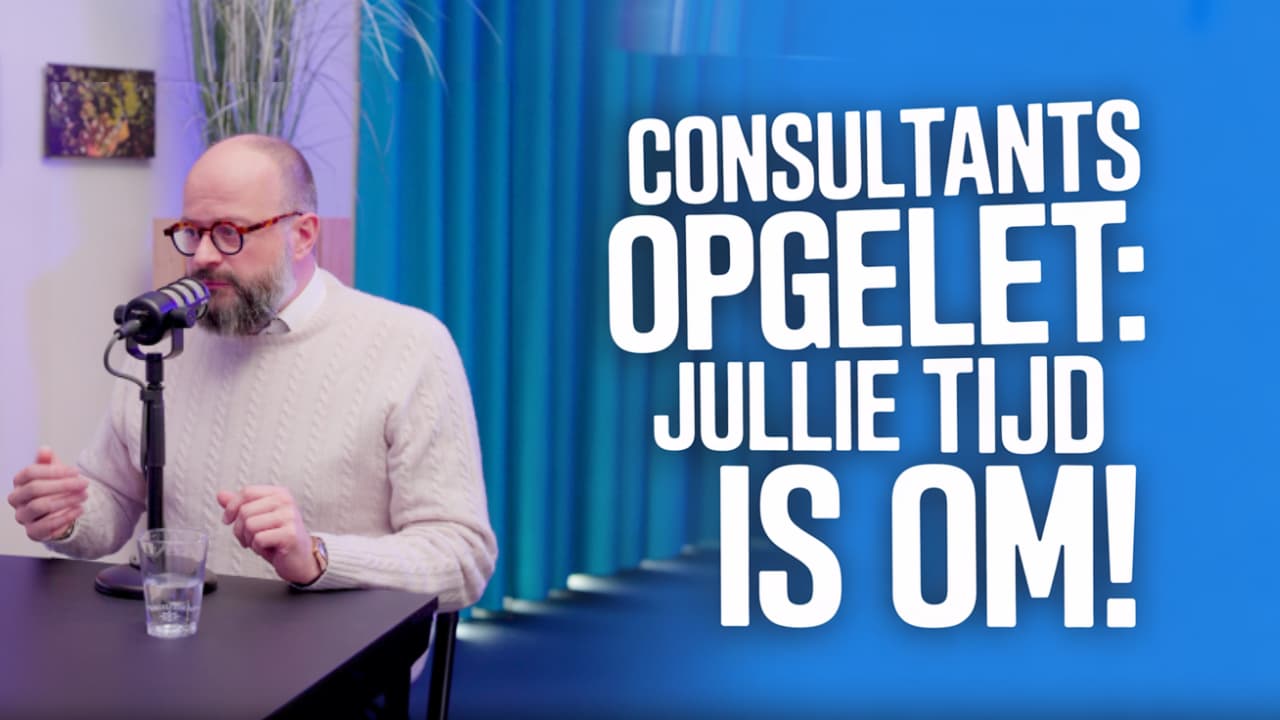
The Belgian SME market is seeing a clear shift: away from classic IT consultancy and toward Digital Challengers—experts who don't just advise, but who implement and embed change. That's the view of Odum, a collective of around twenty independent professionals, in a conversation with De Industrie Online. Founder Olivier Mangelschots and Tim Bertens (Digital Challenger and Fractional CIO) explain how their fractional model (a few hours per week, typically over 2–3 years) redesigns organizations holistically—from strategy and processes to data architecture and tool selection.
"We don't come in to digitize what already exists. We challenge how the company works—internally and toward the market—and build a better operating model," says Mangelschots.
Why this matters
Model shift: SMEs (30–600 FTE) are increasingly choosing fractional CIOs who work vendor-independently, rather than product-driven consultancy.
Holistic mandates: In SMEs, the decision-makers are at the table (owner/CEO), so organization-wide transformations actually take hold.
Focus on embedding: Odum builds tailored governance and sets up a buddy system with internal profiles, so the organization remains self-sufficient.
The model: from advice to demonstrable impact
What changes?
From infra to business: Standardize and delegate infrastructure & security to an MSP with SLAs; deploy internal IT on integrations, data and low-code.
Architecture before tooling: First align the operating model & processes, then select ERP/WMS/MES.
Fractional presence: Experts work within the business to make change stick—without a full-time cost.
"The difference between advice and value lies in the implementation. That's where you reap the rewards," says Bertens.
Case in brief: merge first, then Odoo
At a medical retailer with two operating companies, Odum first advised a merger (with business units per product line) and only then the combination of Odoo with a sector-specific front end. The result: a simpler P&L, less friction (one payment terminal per store), and a lighter, scalable architecture. The lesson: business structure before system choice.
AI: a lever, not a magic bullet
Odum distinguishes three layers in modern SME architecture:
"Many organizations are firefighting. A few weeks of a helicopter view and a roadmap bring both calm and speed," says Mangelschots.
Resistance? Free up capacity and focus
Transformation often fails due to a lack of time among key people who also have to run operations. Odum advocates realistic freeing-up (or temporary capacity), buddy pairs between Odum and internal staff, and lightweight governance (priorities, ownership, decision points).
From dependent to self-sufficient
Odum explicitly positions itself in the change phase. After the implementation, an internal team remains that can continue the projects. During new growth waves, Odum can temporarily step back in—dependency is not the goal.
Getting started in practice: discovery without the sales pitch
Interested companies can schedule a discovery workshop (approx. 2 hours) with the owner/management/leadership team. The goal: to listen, map out ongoing initiatives, and deliver a compact report as a basis for the roadmap. (Bookable via Calendly; link on request.)
FAQ
What is a Digital Challenger? An expert who rethinks organization, processes, data and tooling based on business goals, and who guides and embeds the change.
What is a Fractional CIO? A part-time CIO who works a few hours per week, both strategically and operationally, to bring IT and data up to standard.
Which tools does Odum use? Vendor-independent. Depending on the context: Odoo, Business Central, NetSuite, SAP, supplemented with best-of-breed and edge automation.
How quickly are results seen? Noticeable within a few months (less waste, faster lead times); structural impact over 12–24 months.