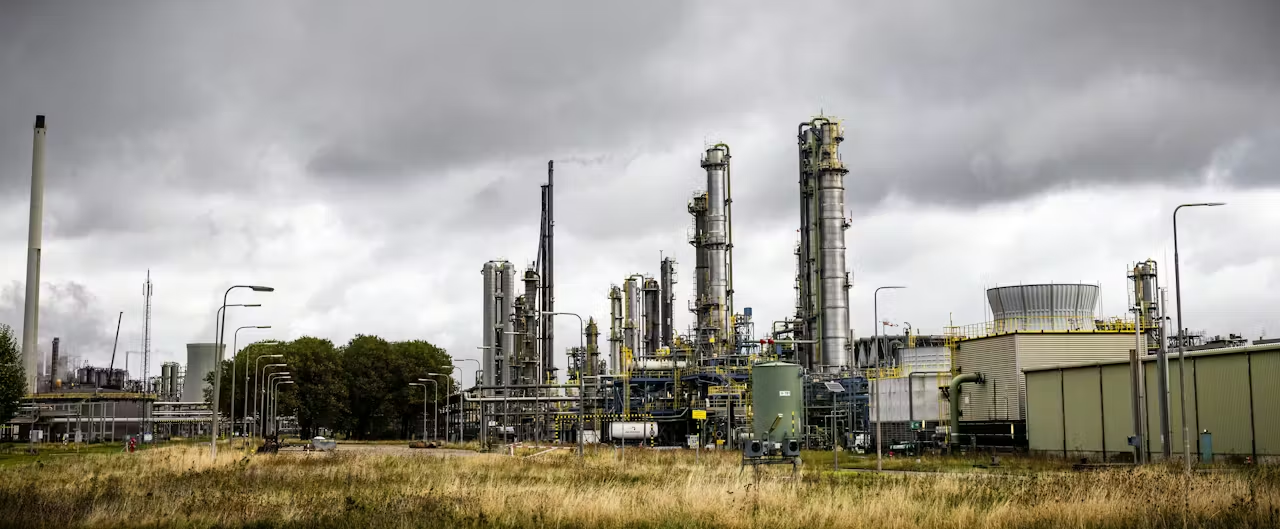
The large Chemelot chemical complex in South Limburg is known as one of the most integrated industrial clusters in Europe. With a combined turnover of around €10 billion, more than 8,000 direct employees and tens of thousands of indirect jobs, the site forms an economic backbone for the region. But behind the scenes, tensions are rising. While Chemelot wants to accelerate its transition to sustainability and aspires to a pioneering role, key links are falling away and investments are under pressure from high energy prices and international competition.
A hydrogen dream on shaky ground
Space has been reserved on the site for two large new installations by energy giant RWE, each representing an investment of around €1 billion. The so-called Furec plants are intended to convert residual waste into sustainable hydrogen, making several factories at Chemelot less dependent on natural gas.
But the arrival of these plants is anything but certain. The main future customers — including OCI and Fibrant — are themselves in serious difficulty. OCI has put two ammonia plants up for sale and is grappling with unfair competition from countries where gas is cheaper. Fibrant recently even announced that it wants to close three factories, with more than a hundred jobs potentially disappearing.
An ecosystem that wobbles as soon as one link falls away
Chemelot is built on mutual dependence: companies supply each other with raw materials, energy and semi-finished products. It is precisely this interconnectedness that gives the site its strength — but it also makes it vulnerable. As soon as one factory drops out, other companies feel it immediately.
Municipalities and the province of Limburg are closely monitoring every development. With Chemelot responsible for an estimated 30% of the Limburg economy, any contraction would have major consequences for both employment and innovation in the region. That is why local authorities are lobbying for around €2 billion in support from The Hague to accelerate the cluster's transition.
Crackers, plastics and geopolitics
The uncertainty is compounded by earlier interventions. For instance, Sabic, part of Saudi Aramco, shut down one of its crackers — a crucial plant for the production of base chemicals. For many companies on the site, this meant the loss of an essential raw material stream. At the same time, Sabic is investing in a new recycling facility that converts plastic waste into pyrolysis oil, a more sustainable alternative to fossil naphtha.
This underlines a broader trend: some companies are taking steps towards circularity, while others are dropping out because sustainability is too costly or energy too expensive.
Air for the energy bill
According to site director Koos van Haasteren, electricity costs in particular are holding back Chemelot's development. Germany and Belgium lie just next door — countries where power is considerably cheaper. For Chemelot, this means an annual cost difference that can run up to €50 million.
In addition, the permitting process is completely stuck. A planned 380kV connection intended to help make the site more sustainable should already have been in place. But the current planning has been pushed back to 2033.
Departures and newcomers
In recent months, Chemelot has seen several companies leave or scale down:
- Vynova is halting PVC production in Geleen.
- Uniper cancelled a syngas plant costing half a billion.
- Fibrant is threatening to close sites.
Yet there is also new interest. Foreign companies — including investors from Canada and France — are actually exploring whether they could establish themselves in Limburg. The space freed up by departing companies could even be an opportunity for them.
The stakes: a fully circular chemical park by 2050
Chemelot is working on a hundred sustainability projects that together cost around €10 billion. The ambition: to become Europe's first fully circular and climate-neutral chemical cluster by 2050.
But the urgency is growing. Because although the cluster still has innovative companies, high-quality expertise and a unique infrastructure, the question is: does the Netherlands want to keep this industry?
Van Haasteren is clear:
- OCI's plants will stay — although possibly under a new owner.
- Sabic will keep its cracker running.
- But without support and faster procedures, the Netherlands will lose a strategically strong cluster that provides the foundation for countless industries.
A moment of truth
The future of Chemelot therefore hangs by several threads:
- Energy prices that must become competitive.
- Permits that must be processed faster.
- Companies that must be willing to invest in sustainability.
- Government support that is badly needed in an international market where other countries act much faster.
One thing Van Haasteren makes clear:
Chemelot will not simply shut down, but without measurable support the Netherlands will miss a unique opportunity to play a leading role in sustainable industry.