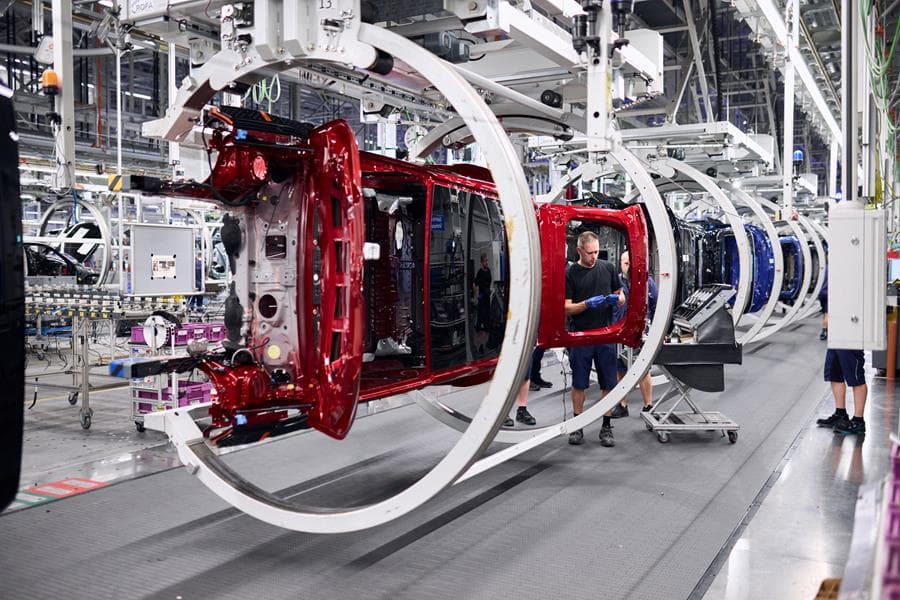
Preventing unplanned downtime is the goal of the smart analysis system used in assembly at the BMW plant in Regensburg. The predictive maintenance system is both proactive and preventive, which is exactly what the intelligent monitoring system offers.
Using data-driven analysis of transport equipment makes it possible to detect and avoid potential faults early on, thereby maintaining optimal vehicle production. Supported by artificial intelligence, the system prevents an average of some 500 minutes of disruption per year in vehicle assembly at the Regensburg plant alone.
Improved, preventive response time.
During assembly at the BMW plant in Regensburg, vehicles are usually attached to mobile carriers or skids that move through the production halls on a chain. Any technical fault in these advanced transport systems can bring the assembly lines to a standstill, resulting in more maintenance and therefore higher costs.
To prevent such situations, BMW's innovation team in Regensburg has developed a system that can detect potential technical defects early on, thereby avoiding loss of productivity. The conveyor belt elements can be removed from the assembly line and repaired elsewhere, outside the production environment. One advantage of this system is that the monitoring system requires no additional sensors or hardware, but evaluates existing data from installed components and conveyor belts. If any deviations are detected, an alarm is triggered.
The carriers that transport the vehicles along the assembly line send various data to the carrier's control system. This data is then forwarded via the carrier and plant control system to BMW Group's cloud-based predictive maintenance platform.
This is where the analysis begins: the algorithm continuously looks for deviations, such as fluctuations in energy consumption, abnormal conveyor belt movements or poorly legible barcodes that could lead to a fault. When deviations are detected, the maintenance control centre receives an alert, which is then assigned to the maintenance technician on duty. “The monitoring system in our control centre is active 24/7,” says project manager Oliver Mrasek. “This enables us to respond quickly to any fault and remove the affected vehicle from the cycle.”
Deploying Artificial Intelligence (AI)
Predictive maintenance is highlighted as being no standalone solution, as Mrasek emphasises. The system has been standardised in collaboration with BMW Group's central shopfloor management to facilitate rapid and streamlined implementation in other plants. This approach also proves to be particularly cost-effective: “We don't need any additional sensors, so our costs are limited to storage and data processing costs.”
Machine learning models have been developed within BMW Group and integrated into the system, which uses heatmaps with various colour codes to visually display deviations. “This allows us to trace different fault patterns in components and respond strategically,” Mrasek explains.
The algorithms are continuously improved and refined on the basis of practical data. The team is currently working on connecting additional installations to further optimise the system and to integrate recommended actions into fault reports. For example, a fault report may indicate similar problems elsewhere in a system, which simplifies troubleshooting for technicians. “Optimal predictive maintenance not only saves money, but also means we can deliver the planned number of vehicles on time, which makes production considerably less stressful,” adds Deniz Ince, the team's data scientist.
The pursuit of predictability.
Mrasek and his team have spent the past six years developing this data-driven monitoring system. Currently, around 80% of the main assembly lines are monitored in this way. “Of course, we cannot detect or prevent every fault in advance, but at present we are avoiding at least 500 minutes of downtime per year in vehicle assembly alone,” says Mrasek.
Calculating the savings is straightforward. At the Regensburg plant, a vehicle rolls off the line roughly every minute, and the system is already in use in the conveyor belt systems of plants in Dingolfing, Leipzig and Berlin.
The aim is to explore the possibilities of AI further, with the system learning to estimate how much time elapses between the detection of a fault and potential downtime. This can help technicians plan maintenance by setting priorities. Mrasek also sees potential in other areas of the plant: “We are currently testing whether we can also use the system for the equipment needed to fill vehicles with brake fluid and coolant, for example.”
Although several options for predictive maintenance already exist, the integrated learning system in Regensburg is so far unique of its kind. When purchasing new conveyor belt technology, compatibility with predictive maintenance is already taken into account. Equipment manufacturers praise the system because they benefit from the evaluations it provides. BMW Group has already filed two patents for the system, which is testament to its innovative nature.