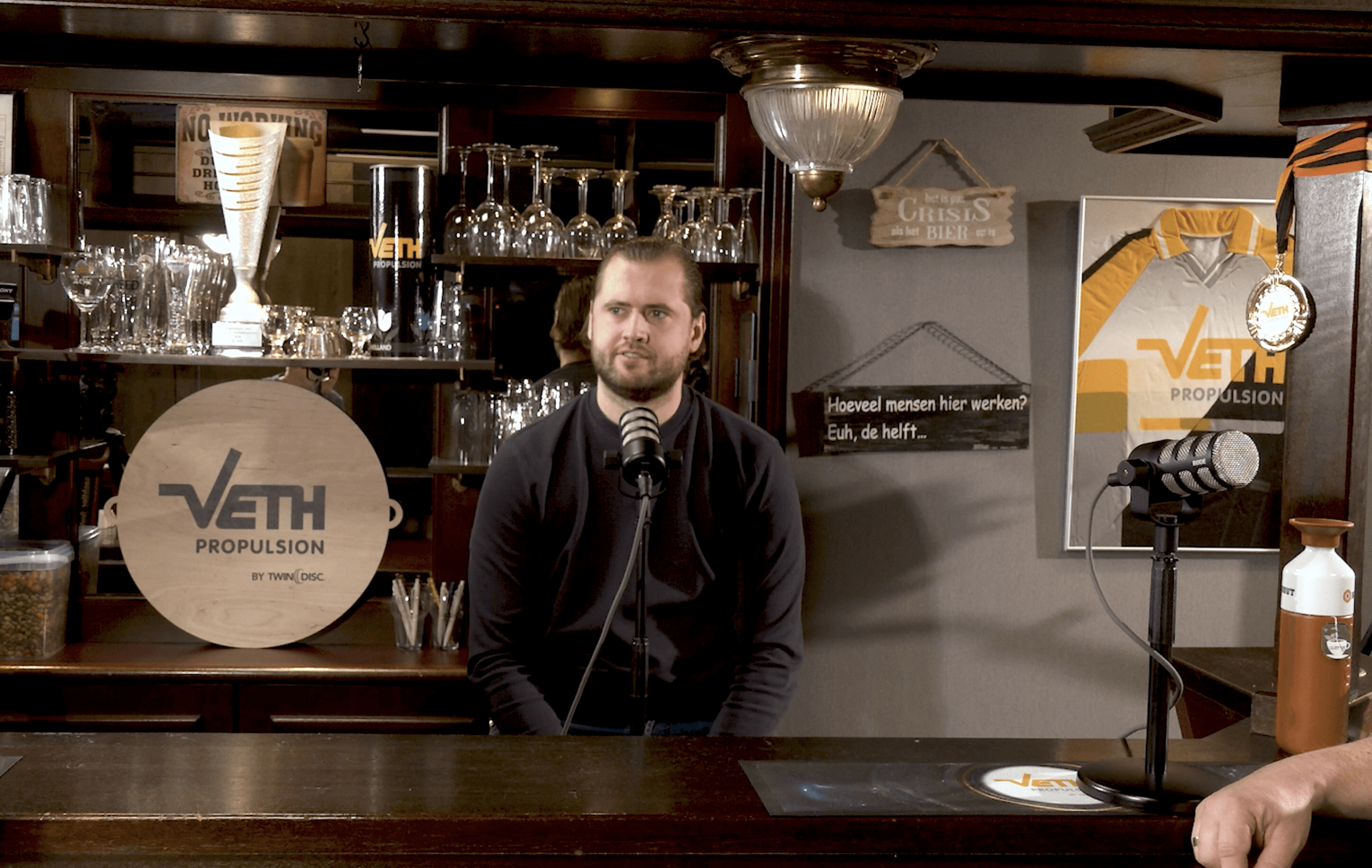
A bolt, nut or washer looks like a minor item on paper. In practice, however, the real cost often lies not in the product itself, but in everything around it. Ordering, booking in, storing, counting, searching, replenishing and processing invoices: it is precisely with low-value items that these indirect costs add up quickly. That is exactly the starting point of the collaboration between VETH Propulsion and Kobout.
The fourth episode of the podcast series makes clear how this collaboration works in practice. VETH Propulsion, a specialist in propulsion systems for the shipping industry, uses Kobout not only as a supplier of fasteners, but as a logistics and process partner. Together with Kangaroo, which provides the VMI solution, a system has been set up in production designed to reduce handling, cut hidden costs and improve supply reliability.
Why fasteners cause so many hidden costs
According to Jure Busse, strategic buyer at VETH Propulsion, the biggest gains with fasteners do not come from a few percent difference in the product price. A ten-cent fastener that becomes 10 percent cheaper barely delivers anything. The real savings lie in the process around it: fewer administrative costs, less handling, less inventory work and less internal disruption.
That is an important insight for many industrial companies. It is precisely the items with a low unit price that are often underestimated internally, while they consume relatively large amounts of time in logistics, inventory management and administration.
Why VETH Propulsion does not work with standard packages
VETH Propulsion is not a producer of catalogue products. Every project is specifically engineered for the customer's application. As a result, every fastener package is different. There is therefore no fixed standard set that contains the same items time after time. This makes the logistical challenge more complex, but it also explains why flexibility and customisation are so important in the collaboration.
Kobout had already played a role for some time as a supplier of fasteners, but over the years the collaboration has broadened. Not only through sets and kits, but also through the transition to a VMI system.
VMI as an answer to too much handling and too much waste
At his previous employer, Jure had already gained experience with Vendor Managed Inventory. When he joined VETH, he saw that the company was not yet working this way. That became the starting point for research: what benefits could a VMI approach offer, and how large would the savings actually be?
For this, they looked not only internally but also set up an internship assignment. Two students investigated the total savings, including time measurements for booking in goods, storing items, inventory work and invoice processing. That analysis showed that on a fastener turnover of around 25,000 euros, a saving of roughly 4,000 euros was possible. That amounts to roughly 15 to 20 percent.
This is exactly the kind of saving that is not immediately visible on paper, but that certainly weighs heavily in practice.
How VETH Propulsion cleverly combines kits and VMI
The solution at VETH is not black and white. They did not opt for only kits or only inventory bins. Instead, a combination was created. Because VETH works with production cells and a very broad range of fasteners, they examined which items are best made directly available in the production cell and which are better kept packaged per project.
This resulted in a clear division. Nuts, washers and other fast-movers were placed in the production cells via the VMI system. Certain bolts continue to be delivered in packages. In this way, the most frequently used and low-value items are directly available to fitters, while project-specific parts remain packaged in a targeted manner.
This mix lowers the assembly costs of kits while at the same time reducing the risk of running short on the shop floor.
From fasteners to broader product groups
What makes the collaboration even more interesting is that it is no longer limited to fasteners alone. According to Jure, together with Kobout they have also looked at other "low-value" items that cause many internal costs and are therefore interesting to bring into the same logistics model.
That is a logical next step. Because if the model works for fasteners, expanding it to comparable product groups is an obvious move. It is precisely in this kind of broadening that the greatest structural gains often arise.
Why fitters work faster with VMI in the cell
A practical advantage of VMI is explained very tangibly in the podcast. When a fitter works with pre-counted kits and drops a washer, that washer really has to be found, otherwise the set is no longer complete. But if the same washer is simply available in a VMI bin in the production cell, they simply grab a new one. That is faster, cheaper and avoids unnecessary searching or walking back and forth to the warehouse.
For fitters this is immediately noticeable. They have to improvise less, search less and can simply keep working. As a result, the system is quickly accepted internally.
How RFID and bin management increase supply reliability
At VETH Propulsion, supply reliability plays an increasingly important role, because the company is growing strongly and the occupancy rate in production is high. Any delay or downtime therefore has a direct impact on planning and deliveries to customers.
The VMI system is designed to absorb this. When a bin is empty, a signal is given via an RFID tag that replenishment is needed. For certain items, a safety stock is also maintained so that they always remain quickly available. The bin size can also be flexibly adjusted if it turns out that an item moves faster than expected.
That flexibility is crucial. A system only works well if it moves in step with actual consumption.
Kobout not only guarantees delivery, but also thinks ahead
According to Joost, Kobout's role does not stop at replenishing bins. For special items that fall outside the standard range, extra stock is built up if it has been agreed that they must always be available. If a supplier cannot deliver on time, a signal is immediately triggered and alternatives are sought, such as sourcing elsewhere or flying items in on an expedited basis.
This makes Kobout, in this context, not only a supplier but a party that actively thinks along about supply security and risks in the chain.
Growth makes smart fastener logistics more important than ever
The context at VETH Propulsion is not unimportant here. The company is growing strongly, now employs around 180 to 190 FTE and has an order intake that puts pressure on production capacity. Part of the assembly activities is even now being placed with sister companies within Twin Disc to absorb the growth.
It is precisely at such times that the supply reliability of small components becomes strategic. Because the fuller production is, the greater the impact of every missing part. That is also why it is possible to quickly roll out the VMI concept to other production sites. According to Joost, such a system can, if needed, be operational within a week.
Why the choice ultimately fell on Kobout again
Interestingly, VETH also worked in the past with another, internationally operating supplier, partly because it could deliver closer to several locations within the group. Yet in practice this turned out not to be the best route. The start-up was difficult, and adding materials other than fasteners proved more challenging. After that, the collaboration with Kobout was resumed.
For about three years now, that collaboration has been running at full speed and, according to Jure, to satisfaction. This shows that scale alone does not tell the whole story. Ease of use, flexibility and the extent to which a supplier can truly align with the customer's process are at least as decisive.
The biggest lesson for buyers: don't only look at the invoice
Perhaps the strongest message from the episode is Jure's call to other entrepreneurs and buyers. Do not only look at the visible costs on the invoice, but rather at the hidden costs for which no invoice arrives: the time spent on logistics, administration, inventory counts and internal handling.
That is precisely where, in his view, the greatest gains are to be made. Especially with items that have a low product value but a high processing burden.
The collaboration is being expanded further
The ambition does not stop at the current set-up. VETH and Kobout are already looking further ahead. Vending machines have recently been introduced in production, so that fitters also become less dependent on the central warehouse for other materials. In addition, they are examining which additional items are eligible for inclusion in the system.
A factor here is also that VETH, as an OEM, can sometimes make favourable price agreements directly with manufacturers, while Kobout or Kangaroo handles the logistical execution for a logistics fee. This too shows how the collaboration is increasingly shifting from pure purchasing to smart supply chain orchestration.
Conclusion
The collaboration between VETH Propulsion, Kobout and Kangaroo shows that the biggest gains with fasteners often lie not in the unit price, but in the process around it. By cleverly combining kits with VMI, making fast-movers directly available in production cells and automating inventory management, hidden costs become both visible and manageable.
For industrial companies that still look mainly at the invoice price of fasteners, there is a clear lesson here. Anyone who wants to purchase more smartly should not only buy more cheaply, but above all deal more intelligently with handling, administration, inventory and availability. And that is precisely where the strength of this approach lies.
FAQ
What does VETH Propulsion do?
VETH Propulsion develops and supplies propulsion systems for the shipping industry, including mechanical components, control systems, and its own software and hardware.
What does the collaboration with Kobout deliver?
According to VETH, the collaboration mainly delivers fewer hidden costs, fewer administrative tasks, more unburdening and better availability of fasteners and other low-value items.
What is the advantage of VMI for fasteners?
With VMI, fast-movers are directly available on the shop floor and are automatically replenished. This prevents searching, running short and unnecessary handling.
How large was the calculated saving at VETH?
On a fastener turnover of around 25,000 euros, a saving of roughly 4,000 euros was calculated, about 15 to 20 percent.
Does VETH only use fasteners in this system?
No, the system has by now also been expanded with other low-value items alongside fasteners.