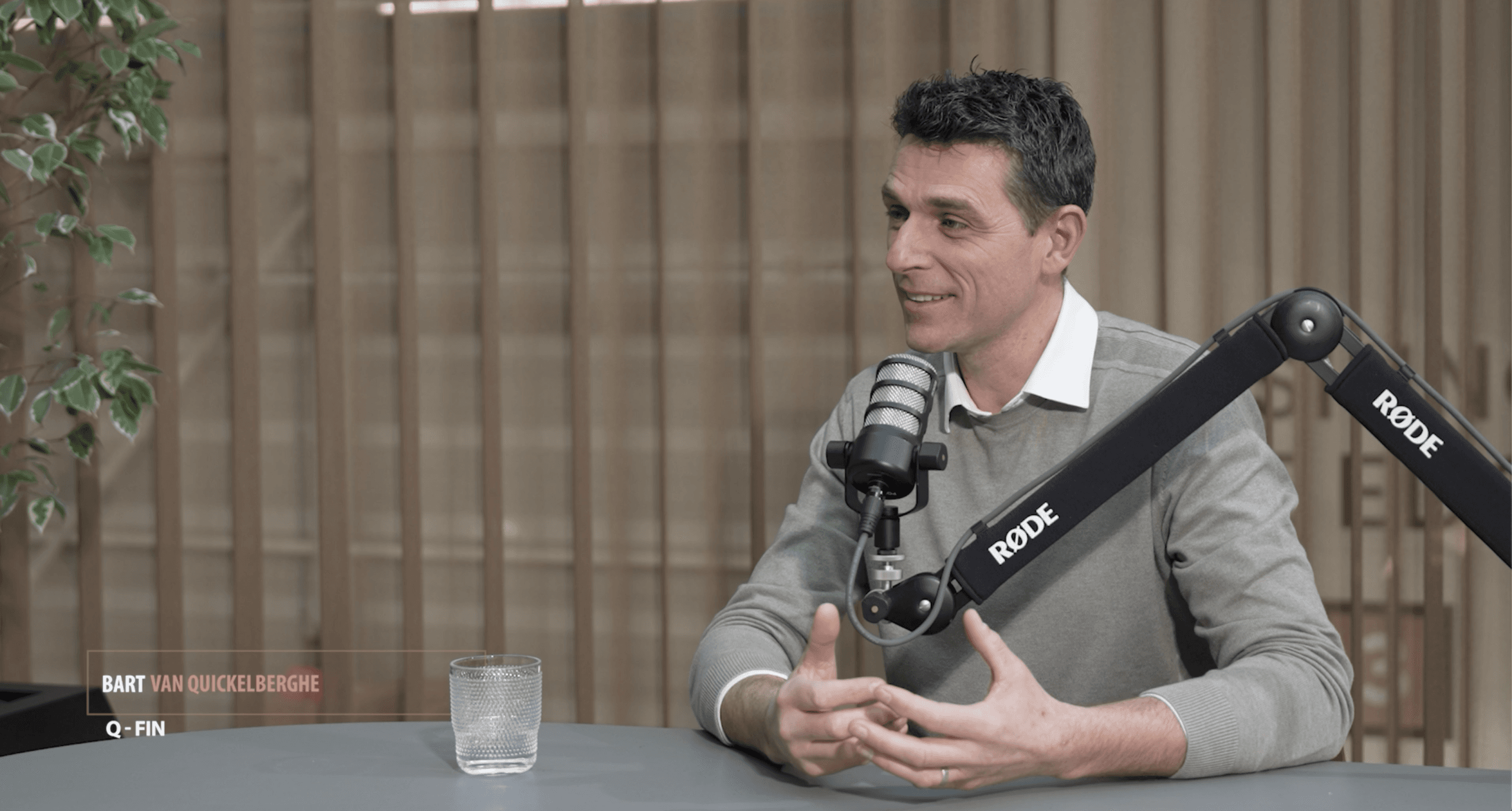
Robotics and cobots are increasingly cited as an answer to labour shortages, growing pains and quality pressure in the manufacturing industry. Yet doubt continues to linger at many companies. Does it really work? Is it affordable? And does it actually fit into an existing production environment? According to Bart Van Quickelberghe, these questions are often still asked from the wrong starting point. Because anyone who sees robotics simply as “adding a robot” misses exactly where the real added value lies: not in the robot itself, but in the complete system solution around it.
In this episode, Niko Saris talks with Bart Van Quickelberghe about the practical realities of robotics in handling. The common thread in the conversation is clear: robotics only truly works when vision, gripper, software and the finishing process merge into one logical whole. And that, he says, is precisely where things still too often go wrong in the market.
Robotics in handling isn't about the robot, but about the whole system
According to Bart Van Quickelberghe, robotics in handling is so central today because handling is essentially about picking up, turning, feeding and positioning parts. That kind of repetitive work lends itself perfectly to automation from a technical standpoint. But that's not the end of the story. The real value only emerges when the robot is intelligently embedded in the process it is part of.
This is what sets this wave apart from earlier automation waves. In his view, it is no longer just about a robot arm or a mechanical movement, but about intelligence in the system: vision, grippers and robotics must work together as one integrated solution. That makes it not only smarter, but also far more accessible to teach new products and to keep production flexible.
The real problem robotics solves isn't technology, but a shortage of people
When Niko Saris asks why handling tasks in particular lend themselves so well to robotisation, Bart Van Quickelberghe quickly gets to the heart of it: above all, it solves a pressing shortage of hands. A lot of handling work is repetitive, boring or physically unappealing. Think of small products that need to be fed 24/7, or conversely large, sharp and heavy sheet metal parts that require specialist handling.
These are precisely the tasks for which companies are finding it increasingly difficult to recruit people. Robotics, he says, does not fully replace people, but it does make an organisation less dependent on scarce capacity. And for many companies today, that alone is reason enough to take a serious look at an automated handling solution.
Companies don't just want a robot, they want independence
According to Bart Van Quickelberghe, in practice companies are not just looking for a piece of technology, but above all for greater independence. They want an installation that can run day and night, that adapts to changing conditions, that can handle new products and that doesn't grind to a halt entirely when an operator is briefly unavailable.
In that respect, he also links robotics to what he calls Industry 5.0: not only connected machines and data, but also sustainability, energy efficiency and solutions that remain usable for people on the shop floor. Companies, he says, want to become more efficient, achieve better quality and at the same time build a system that grows along with their organisation and their market.
Most companies only take action when they hit a wall
In practice, Bart Van Quickelberghe sees that companies usually don't start with robotics out of curiosity, but because a bottleneck has arisen somewhere. They want to grow but have too few people. They lack space. Or they can no longer achieve the desired quality level. At that point they aren't looking for a standalone machine, but rather a sparring partner or consultant who understands their situation and can make it automatable.
That, he says, is also exactly where the difference lies between simply selling a robot and building a genuine handling solution. You first have to understand the customer's world before you can indicate what robotics will concretely improve there.
Why earlier robot projects often failed
In the conversation, Niko Saris also raises a fair question: what if a company has already tried this and it failed at the time? According to Bart Van Quickelberghe, the explanation often lies in the fact that robotics was approached too much in isolation. “Bolting on” a robot unit to an existing finishing line rarely works well, he says. The speed of handling has to match the pace and character of the finishing process. When that isn't in balance, friction arises.
That's why he argues that robotics in handling is only truly successful when the integration is designed entirely around the whole process. Finishing and handling, in his view, are not two separate worlds but a single story. And that, he says, is precisely where Q-Fin sets itself apart.
What companies often get completely wrong
One of the most interesting parts of the conversation concerns expectations. According to Bart Van Quickelberghe, there are two recurring mistakes in thinking. The first is that companies think they can put down a robot tomorrow and that it will immediately take over 100 percent of their production flawlessly. That, he says, is a mistaken expectation. The second mistake is the opposite: that because of this uncertainty companies decide not to start at all. That too, he says, is wrong.
Because, as he puts it very directly: robotics always delivers gains for companies that are running up against a clear bottleneck. Capacity, efficiency, quality and staff availability almost always improve in such situations. Not because it's a miracle cure, but because it specifically removes a bottleneck.
Too expensive, too difficult and too complex? That picture is increasingly wrong, he says
Another persistent objection Bart Van Quickelberghe mentions is the idea that robotics is unaffordable or too complicated. On the contrary, he says these concerns have become much smaller. Companies can now gain far better insight in advance into payback time, ease of use and implementation risk. And that, he says, is precisely what their approach focuses on: low-threshold automation, quickly visible gains, and ease of use that doesn't scare operators off but supports them.
What's different today compared to ten years ago
Niko Saris then raises a thought many entrepreneurs will recognise: didn't these kinds of solutions already exist ten years ago? According to Bart Van Quickelberghe, the difference is simple: the market is now ready for it. The technology has had time to mature, just as other digital technologies have. Where something once felt complex or experimental, it is now more widely accepted because companies see the added value concretely.
On top of that, suppliers such as Q-Fin have, in his view, deliberately invested in recent years to make the concept market-ready. Not as a story, but as something you can literally show. And that visual proof, he says, removes a lot of doubt.
The biggest technical challenge is often at the front end
When Niko Saris probes the technical side, Bart Van Quickelberghe makes clear that the trickiest question often lies not in the robot itself, but in the upfront analysis. How large is the product variation? What does a customer actually produce on an annual basis? Which solution fits that mix? That requires a lot of preparation in the pre-sales process, he says.
That's why Q-Fin has invested heavily in tooling to get that upfront analysis right. Not with a generic robot that “fits everything”, but with a substantiated choice that matches the production of that specific customer.
Why standardisation matters more here than specialisation
Another striking point in the conversation is the emphasis on standardisation. According to Bart Van Quickelberghe, customers sometimes think they mainly need something highly specific: special grippers, gripper changes, extra options, all kinds of exceptions. But in his view, every special also introduces additional complexity, risk, longer lead times and less ease of use.
That's why the starting point within Q-Fin is precisely to work with standards that cover virtually all applications. Not because custom work is never needed, but because standardisation delivers reliability and scalability. And that, he says, is today one of the greatest strengths of their handling approach.
Flexibility doesn't come from specials, but from modular design
That naturally raises the question of how flexible such a standardised system still is. To this, Bart Van Quickelberghe responds that flexibility actually arises through modularity. Each module can work on its own, but is at the same time prepared to be linked later to a next module. Half a line can be doubled later. A line without robotics can be expanded into a line with robotics. A single-sided line can grow into double-sided finishing.
This means a customer doesn't have to make an all-or-nothing decision. The line can grow along with the organisation, as long as the foundation is set up intelligently.
The hardest part of implementation is often not the machine, but the people
As the conversation turns to implementation, it becomes clear that the human factor, according to Bart Van Quickelberghe, is at least as important as the machine factor. Operators have to get used to a different way of working. Someone who has spent twenty years manually setting all parameters suddenly has to deal with fixed programmes and a more automated flow. That takes some getting used to.
He doesn't see this as a problem, but rather as a reality that must be actively guided. The behaviour of operators, the mentality within the organisation and the openness to change strongly determine, in his view, whether automation truly becomes successful.
An operator doesn't become a redundant link, but a process monitor
An interesting point in the conversation is how the role of the operator changes. According to Bart Van Quickelberghe, it shifts from manual feeding and adjusting to monitoring the process as a whole. The operator thus becomes more of a supervisor than an executor. He or she no longer places each part one by one on the belt, but keeps an eye on the flow, availability and continuity of the process.
That, he says, is not only a different task but also a higher level of responsibility. And it is precisely here that he sees great value for the people already working on those lines today.
Maintenance must above all remain simple and affordable
In the area of maintenance, accessibility has also been a deliberate choice. Bart Van Quickelberghe explains that Q-Fin works with two solution directions: cobots for smaller and lighter parts, and Cartesian robots for situations where higher payloads, greater speeds or more dangerous products come into play. Those Cartesian X-Y-Z systems in particular are interesting, he says, because they are almost maintenance-free.
This prevents customers from becoming dependent on an external specialist for every minor maintenance task. Replacing a belt or applying a bit of lubrication is something very different from complex calibration procedures or specialist service work. And that is precisely what lowers the total cost and complexity of such a system.
This is how Q-Fin calculates in advance whether a line is profitable
When it ultimately comes down to euros, Bart Van Quickelberghe wants above all to make clear that profitable automation need not be guesswork. Q-Fin starts, he says, from the customer's production data: all the cut parts that the customer produces on an annual basis are analysed. From this, average dimensions, speeds and utilisation rates are derived. Those parameters are then set against the current situation: how many people, how many shifts, how much material, how much output.
On that basis, a realistic picture emerges of the investment, operating hours, utilisation and payback time. According to Bart Van Quickelberghe, this almost always produces a credible ROI, provided the bottleneck and the actual situation are honestly mapped out.
Cobot or not? That mainly depends on three things
Niko Saris also asks explicitly when a cobot does or doesn't make sense. According to Bart Van Quickelberghe, that depends mainly on footprint, product size and payload. Cobots are a good fit for compact setups, smaller parts and relatively light products. But as soon as speeds go up, products become more dangerous, or multiple pallet positions and larger footprints are needed, the logic shifts towards Cartesian robots.
With this he makes clear that choosing a cobot should not be a trend-driven choice, but a rational process choice.
The realistic expectation: no dream story, but calm and plenty of gains
At the end of the conversation, Bart Van Quickelberghe nicely sums up what a realistic expectation of robotics in handling is. Not 100 percent perfect automation of everything, but calm within the organisation, a very high automatic percentage of the product mass and clear gains in quality, output and staff deployment. According to him, that automatic share lies “high in the ninety-something percent”, but not at one hundred. And that is precisely what Q-Fin wants to be honest about.
That honesty, he says, is also part of success. Not selling a dream, but a system that does what was realistically agreed in advance.
Conclusion
The conversation between Niko Saris and Bart Van Quickelberghe makes one thing clear: robotics in handling is no longer a futuristic experiment, but a serious answer to very concrete problems in the manufacturing industry. Labour shortages, quality pressure, growth blockages and repetitive work are forcing companies to look at their process differently. According to Bart Van Quickelberghe, the gains lie not in standalone robot arms, but in integrated, standardised and modularly expandable systems that truly connect to real-world practice.
And perhaps that is the most important lesson from this conversation: companies need not fear that they'll bring an unaffordable, incomprehensible technology into their operation tomorrow. But they do need to dare to look honestly at where things are pinching today. Because that is where the real business case for robotics begins.
FAQ
Who is Bart Van Quickelberghe?
In this episode, Bart Van Quickelberghe is the specialist who explains how Q-Fin views robotics and handling within finishing processes.
Who interviews him in this episode?
The episode is hosted by Niko Saris.
Why do companies choose robotics in handling?
Mainly because of labour shortages, repetitive work, quality improvement and the desire to produce more independently and efficiently.
Why do robot projects sometimes fail?
According to Bart Van Quickelberghe, often because robotics is viewed too much in isolation from the overall finishing process. Without integration of handling and finishing, things go wrong more quickly.
What is a realistic expectation of robotics?
Not processing 100 percent of all products automatically, but a very high percentage, more calm in the process and clear gains in capacity, quality and efficiency.