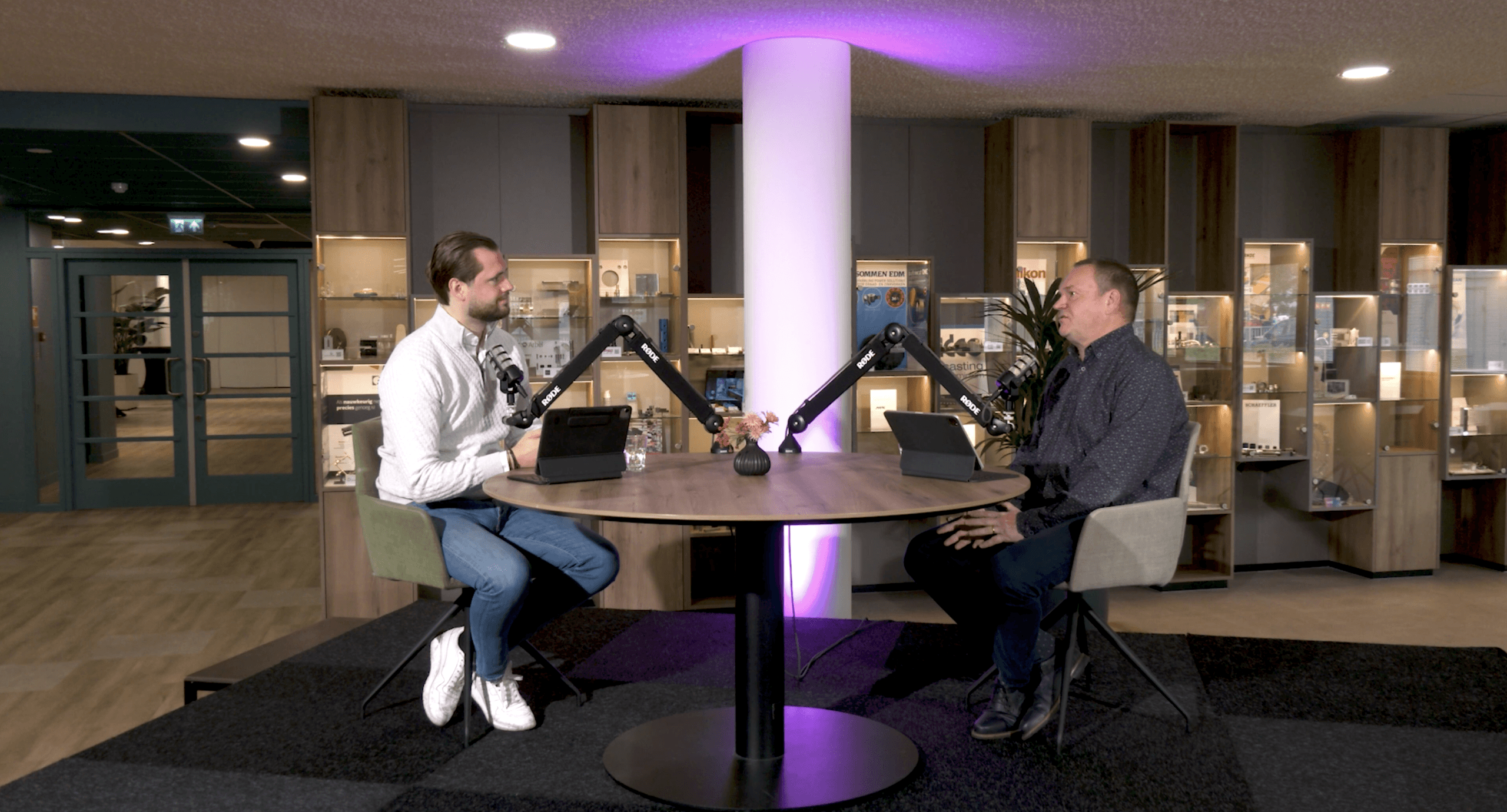
Anyone who still sees automation in metalworking as a standalone project is, according to Janwillem Verschuren, already falling behind. For the managing owner of De Cromvoirtse, automation is not a one-off investment, but a continuous process directly tied to growth, flexibility and future readiness.
In the video podcast, Verschuren outlines how De Cromvoirtse has been working step by step for years towards an increasingly automated organisation. Not driven by hype, but by necessity. Staff are becoming scarcer, customers expect speed and flexibility, and technology is developing at breakneck pace. The question, he argues, is therefore not whether you will automate, but how quickly you learn to do it wisely.
De Cromvoirtse does not supply complete end products, but the basis for them
De Cromvoirtse is engaged in supplying steel and aluminium made to measure. This is done through sawing, cutting, shearing, tube lasering and water cutting. The company welds nothing together, but supplies single pieces and components that customers then use to make their own end products, from machines and fencing to boats and other structures.
That sounds straightforward, but it actually makes automation complicated. De Cromvoirtse works with many different single parts, little repeat work and hardly any long, stable series. This means that standard automation is far less self-evident than in a classic serial production environment. Whoever automates here must therefore automate flexibility.
The first real driver was staff scarcity
According to Verschuren, it became clear early on that the availability of people would become a structural problem. During the period when De Cromvoirtse was already working extensively with Polish employees, the realisation grew that this labour market too would not keep supplying indefinitely. And if you keep following that line of reasoning, you eventually reach a point where you have to think about how to keep producing when the people simply are no longer there.
This gave automation a different meaning. Not as a nice innovation, but as a necessary step to keep the company running in the longer term.
It all starts with one conviction: it can be done
Perhaps the most important line from the conversation is also the simplest: it can be done. According to Verschuren, automation does not begin with the question of what is impossible, but rather with the idea that there is always a way to organise something more cleverly, better or differently. That mindset is deeply embedded in the way De Cromvoirtse looks at renewal.
This also demands something of suppliers and partners. A supplier who too quickly says "that can't be done" is, in his view, no help. Value arises precisely with parties willing to think along, to investigate, and prepared to look together at how something can be achieved, even if in steps.
Looking outward is not a luxury for De Cromvoirtse, but a necessity
A second important element in De Cromvoirtse's approach is actively gathering knowledge from beyond its own walls. Verschuren says explicitly that new ideas do not arise solely by sitting behind a screen. You have to visit trade fairs, attend networking events and also look beyond your own industry. Sometimes a good idea lies not in metal, but in wood, glass or an entirely different sector.
He emphasises that he himself often sees something at another company and thinks: that's clever, I could apply that too in an adapted form. It is precisely this attitude that turns automation from an isolated internal process into a learning journey fed by the outside world.
The road to automation began back in 2008
The first important step was the web portal launched in 2008. This brought part of the order flow in digitally, but it did not yet solve the entire challenge. Because once that order comes in, the real work in the factory only just begins. And at that point, much of it was still done manually.
From that starting point, De Cromvoirtse gradually automated the factory further. Not in one big leap, but in separate components that together increasingly form an integrated whole.
The dark factory was the dream, but built up in pieces
Verschuren explains that there was a larger ideal image early on: a customer who orders in the evening and has their product ready the next morning, without much human handling being needed during the night. That is the dark factory concept that served as a dot on the horizon.
To get there, the big picture was broken down into smaller steps. First the web portal. Then an automatic warehouse. Next automatic loading and unloading of machines, sorting of products, the deployment of AGVs, the automated movement of products to the bending robot and, ultimately, automatic packaging as well.
That is an important lesson from the De Cromvoirtse story: grand automation visions only become achievable if you cut them into manageable intermediate steps.
Part of that dark factory is now a reality
According to Verschuren, the picture of fully unmanned production has not yet been achieved everywhere, but parts of it are indeed already running. At the weekend, for example, production largely continues. The robots keep working, even outside the regular presence of people. This means the dark factory is no longer an abstract idea, but something that has already been put into practice in certain areas.
That makes De Cromvoirtse's approach credible. Not because everything is already perfect, but because the company visibly demonstrates how a vision can slowly be made operational.
Growth was not the alternative to automation, but the result of it
An interesting point from the conversation is that automation at De Cromvoirtse did not lead to a reduction in work, but rather to more turnover. The company's success grew alongside the technological steps that were taken. At the same time, the pressure on staffing remained. Many production employees are still needed and new workers are also hard to find. De Cromvoirtse now works with people from countries including Poland, Romania, Armenia and Syria.
This shows that automation in this context is not a replacement for people, but a way to enable the company's growth despite structural scarcity.
Start with the bottleneck, not with the technology
When asked where you should begin, Verschuren is strikingly practical. You first look at where you get stuck. Where is the bottleneck? Where does delay, quality loss or downtime arise? That is the process deserving attention first.
At De Cromvoirtse, one of the biggest early gains lay in loading and unloading sheets. This was done manually, cost time and caused machines to stand idle unnecessarily during changeovers. On top of that came a quality aspect: people get tired, a robot does not. Where a sheet is easily loaded on Monday morning, it feels heavier on Friday afternoon.
That type of bottleneck is recognisable to many companies in metalworking: it is often not the machines themselves, but the transitions and handling around them that block the real gains.
AGVs and smart logistics are what really make automation scalable
The conversation also makes clear that automation is not only about machine capacity, but very much also about the logistics in between. Once a sheet is cut, offcuts and finished products remain. Residual material goes back to the warehouse. Finished products must be separated per order and temporarily stored until they move further into the factory. This is where AGVs and buffer warehouses come into play.
Because a single sheet can sometimes contain twenty orders at once, that splitting and moving must be done with the utmost care. Whoever automates only the cutting process without properly organising the internal logistics, by this logic, automates only part of the problem.
Automation projects always disappoint
One of the most honest passages in the conversation is Verschuren's warning that automation projects always disappoint in practice. They take longer, cost more and run into problems that were not foreseen in advance. His sober rule of thumb is even that if you think a project will cost x, you had better count on 2x.
That sounds discouraging, but he means it as a realistic warning. Automation is no smooth implementation process. Certainly when you link multiple software packages and systems together, discussions inevitably arise about where a problem comes from. That is precisely why, he says, you must document things properly, agree clearly and work together with parties who genuinely want to solve the same problem with you.
AI is now becoming the next accelerator
Where the earlier automation steps were mainly physical and logistical in nature, De Cromvoirtse is now also looking emphatically at AI. Copilot is already running within the company and employees receive training to learn about its possibilities. But the most concrete example is the project Brutus.
Brutus focuses on orders that do not yet come in via the web portal. Between 80 and 85 percent of orders already come in through that portal, but some customers still send emails with PDFs, DXF files or STEP files. Brutus reads out these files and automatically prepares them for processing in the system.
That is a smart choice, because it addresses a practical problem. You would ideally want to guide customers through your digital process, but customers do not always allow themselves to be fully directed. Then you have to build technology that absorbs that resistance without putting pressure on the customer relationship.
Customers want convenience, not your internal ideal picture
That is precisely where an important lesson lies. A company can decide internally that the web portal is the best route, but large customers with hundreds of files in one order do not always want to enter everything manually. If you do not offer that flexibility, they may look for a supplier who does. De Cromvoirtse therefore chooses to relieve the customer as much as possible, even if that means absorbing the complexity yourself via AI.
This makes the digitalisation strategy customer-focused rather than purely internally driven.
No smart factory without learning people
According to Verschuren, automation requires not only technology, but above all people who want to keep learning. De Cromvoirtse works with an internal IT department, but also intensively with external specialists. At the same time, its own employees are crucial, because they know the company, the products and the customers.
He is clear about this: no one is "finished" after school. Technology changes too quickly and employees must keep growing along with it. Within De Cromvoirtse, change is therefore part of the normal work. New projects, new systems and new ways of working are not the exception, but a fixed part of the culture.
Automation mainly delivers flexibility and less stock for customers
The ultimate value of automation, according to Verschuren, is reflected not only in internal efficiency, but precisely in what customers notice. If De Cromvoirtse can produce faster, smarter and more consistently, customers themselves need to hold less stock. That lowers the risk of material ageing, prevents liquidity from being unnecessarily tied up in components and makes it possible to order later and still receive delivery quickly.
That is an important advantage in supply chains where specifications can change and where stock therefore not only costs money, but also carries risk.
The warning to Europe is harsh, but clear
At the end of the conversation, Verschuren broadens the discussion. After a visit to China, he sees how quickly technology and automation are developing there. His conclusion is sharp: if the Netherlands and Europe do not join in quickly enough, we will miss the boat. In his view, this has already partly happened in the market for electric cars. Europe must therefore collaborate, learn and act faster to remain competitive.
That makes this story bigger than just De Cromvoirtse. Ultimately, it is about the question of how the European manufacturing industry deals with speed, technology and decisiveness.
Conclusion
The story of De Cromvoirtse shows that automation in the metal sector is not a tightly defined project, but an ongoing change process. It starts with the conviction that something can be done, grows through small steps, requires knowledge from outside and inevitably becomes more expensive and more complex along the way than you think in advance. But it is precisely for that reason, according to Janwillem Verschuren, something you cannot avoid.
For companies wondering where to begin, De Cromvoirtse offers one clear lesson above all: do not wait for the perfect moment or the perfect solution. Look at where you get stuck, gather knowledge from outside, seek partners willing to think along and keep reasoning from what can be done. Because standing still, in this market, is not a neutral choice, but simply going backwards.
FAQ
What does De Cromvoirtse do?
De Cromvoirtse supplies steel and aluminium made to measure, including sawn, cut, sheared, tube-lasered or water-cut. The company supplies single pieces and components that customers use to build their own end products.
Why does De Cromvoirtse invest heavily in automation?
Mainly because of staff scarcity, growth, flexibility and the need to keep producing efficiently in the future.
Where did the automation journey begin?
With the web portal in 2008. This was followed by, among other things, automatic warehouse management, loading and unloading, AGVs, bending robots and automatic packaging steps.
What is Brutus?
Brutus is an AI project within De Cromvoirtse that reads out emails with PDFs, DXF and STEP files and prepares them for processing in the system.
What, according to Janwillem Verschuren, is the most important lesson?
Keep thinking from the perspective of what can be done, gather knowledge from outside and do not accept too quickly that something is impossible.