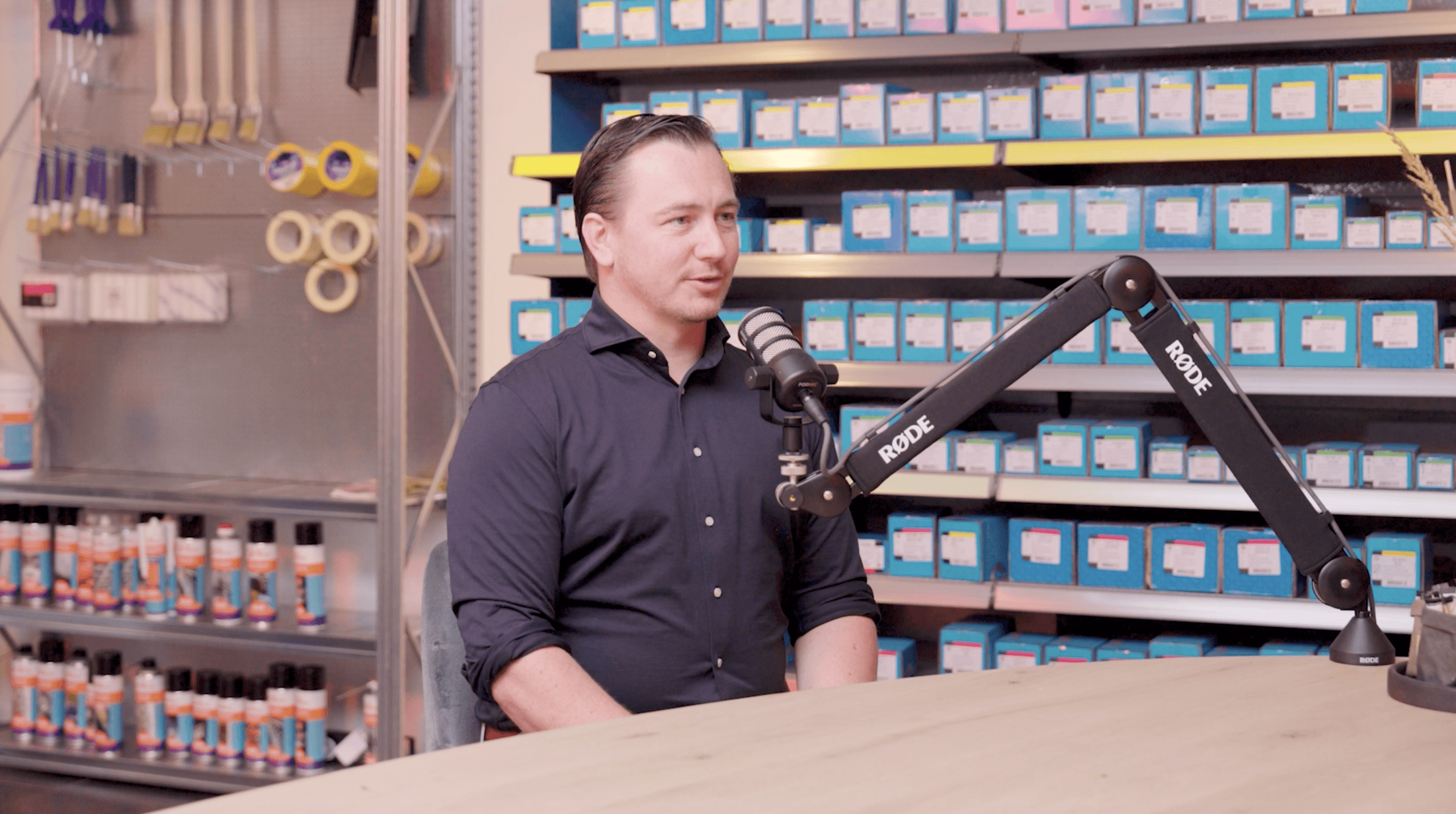
In many production environments, fasteners seem like an afterthought. A bolt, a nut or a washer only draws attention when it's missing. But according to Kobout, that is precisely where the real value of delivery reliability begins. Because the moment such a small component isn't available, an entire assembly can grind to a halt, with all the consequences that entails for planning, lead times and costs.
That's why the third episode of the podcast series around Kobout isn't just about fasteners, but above all about the broader role the company wants to play for its customers. Under the banner “it's more than fasteners”, it becomes clear that Kobout positions itself as a partner that looks beyond a single order line. Relationships, proactive thinking, delivery reliability and tailor-made solutions should help customers avoid shortages, respond faster and work more efficiently.
More than fasteners starts with relationships
According to Joost, Kobout's approach is fundamentally about people. The company doesn't just want to deliver products, but above all to understand exactly what customers need, where the pain lies and what impact a missing component actually has in practice. That requires contact, feedback and long-term relationships with both customers and suppliers.
That perspective is far from insignificant. In a market where many players compete mainly on price and availability, Kobout deliberately opts for a model in which reliability and involvement take centre stage. The idea behind it is simple: if you truly understand the customer's situation, you can also deliver better solutions.
Why delivery reliability can directly save money
For Kobout, delivery reliability is much more than delivering on time. It's about the customer being able to keep their process running. The podcast puts it sharply: a bolt or nut may seem insignificant, but if it's missing, the entire production comes to a standstill.
That's exactly where the hidden cost lies for many companies. It's not the component itself that is expensive, but the delay, improvisation, downtime or extra handling that arises when something is missing. Delivery reliability therefore not only prevents frustration, but can also directly contribute to lower process costs.
Broad and deep stock: the in-between sizes make the difference too
An important part of Kobout's strategy is the breadth of its stock range. Where many suppliers mainly keep the fast movers in stock, Kobout keeps expanding its assortment, including in-between sizes that are far from readily available everywhere in the Netherlands. The podcast specifically mentions that sizes in increments of five millimetres are also kept in stock, so customers don't have to wait weeks for something they need tomorrow.
That choice may seem operational, but it carries strategic weight. Because particularly in maintenance, assembly and project work, the biggest disruptions often don't lie in the standard products, but in the odd sizes or specific combinations that just aren't on the shelf.
Assortment boxes and assembly kits: standard where possible, custom where necessary
Kobout supplies both standard assortment boxes and specific assembly kits. Assortment boxes are designed to give fitters and maintenance teams quick access to the most commonly used components, without them having to maintain a large warehouse. Such a box might contain, for example, various sizes of stainless steel bolts or other fasteners neatly divided across multiple compartments.
Assembly kits go a step further. These are built entirely around the specific needs of a customer or project. That could be a small set of components for a bridge section, but just as easily complete pallets for a larger project. In doing so, Kobout thinks along about quantities, packaging formats, labels, languages, descriptions and even the question of whether something needs to be packed for sea transport or can simply be shipped in cardboard.
This shifts the role of supplier towards process partner. It's not just about what is delivered, but also about how it arrives at the customer in the most logical, efficient and safe way.
Metalworking under one roof speeds up the process
What also sets Kobout apart is that the company doesn't stop at stock and logistics. The podcast reveals that a complete metalworking department has now been built up, featuring, among other things, sawing machines, drilling machines, tapping capabilities and a punching machine. This means products can not only be supplied, but also machined and prepared for direct use in the customer's process.
As an example, a threaded rod is mentioned that is cut to size, fitted with a nut in exactly the right position and then secured so that it can no longer turn. Such operations may sound minor, but they can make a big difference for a customer in terms of assembly speed, error rate and reproducibility.
Precisely because stock, order picking and machining are all under one roof, things can move quickly. There is no need for extra transport between locations, and internal routing is already set up for products that need to go straight on to metalworking.
Fewer failure costs start with good listening
A striking theme in the episode is the attention given to hidden costs. Kobout explicitly states that it's not just about the price of a product, but above all about the time and actions customers spend on ordering, assembling, searching, storing or correcting. To make those costs visible, you first have to know where they are. And for that, listening is essential.
That also explains why Kobout often visits customers first, to see with their own eyes how processes run, where things can go wrong and how a solution best fits in practice. After all, not every solution suits every type of customer. A project organisation calls for a different logistics approach than a production company with repeat orders.
Sawing service and custom work help assemble faster and error-free
Kobout's sawing service is more than just an extra service. According to the podcast, it directly helps customers to assemble faster and with fewer errors. Instead of having to reach for an angle grinder, hacksaw or improvisation themselves, customers receive a product that is already cut to size, neatly finished and ready for immediate use.
This not only saves time but also raises quality. A professionally cut threaded rod, free of burrs or splinters, ensures that assembly goes more smoothly and there is less chance of errors or damage.
Stock management without tying up unnecessary capital
Another important point in Kobout's story is stock management. Out of fear of shortages, many companies hold too much stock, with the result that unnecessary amounts of capital are tied up in components that may not be needed until much later. Kobout tries to prevent this by helping customers with smarter stock models, such as a kanban system or a two-bin system.
The idea is that there is always enough available to keep working, while replenishment takes place automatically the moment consumption reaches a certain point. This replaces hoarding with controlled availability.
Custom work doesn't call for overprocessing, but for logic
Interestingly, Kobout also warns against the opposite problem: too much customisation. The podcast notes that you can sometimes go too far in counting out the smallest components, when in practice a standard box is more logical, cheaper and faster.
This shows that Kobout doesn't see customisation as an end in itself. The question is always: what is the smartest solution here? Sometimes that's a fully counted-out kit, sometimes a standard package, and sometimes a simpler system that requires less handling.
From new business to implementation: acting fast once the need is clear
The podcast also makes clear how such a process typically unfolds at Kobout. New customers first come into contact with the new business team, which uses a broad toolbox to determine which approach fits best. Together they then decide which logistical or technical solution matches the customer's process. Once that need is clear, it's mainly about implementation and getting things done.
According to Joost, tangible results are often noticeable from the very first delivery. Precisely because the improvements directly affect availability, ease of assembly or order processing, customers quickly see the effect in their day-to-day practice.
Why customers come to see Kobout differently over time
At the end of the episode, perhaps the very heart of the whole story emerges: why customers eventually stop seeing Kobout as just a supplier. According to Joost, that comes down to the dedicated points of contact, the long-standing relationships, the involvement of employees and the culture in which knowledge and enthusiasm for fasteners are genuinely visible.
That sounds almost simple, but it's difficult to copy in practice. Because where many business relationships remain transactional, Kobout aims to build a position in which the company thinks along, grows along and makes processes smarter together with its customers.
Looking ahead: at VETH Propulsion it all comes together
The episode already looks ahead to a customer case at VETH Propulsion, a specialist in engines for the maritime sector. According to Joost, all the elements discussed will come together there: kanban, assembly kits and tailor-made logistics solutions.
This makes clear that “more than fasteners” is not a slogan detached from practice for Kobout, but rather a positioning that has to become visible in concrete customer processes.
Conclusion
Kobout emphatically wants to move away from the image of the traditional fastener supplier. Of course fasteners remain the foundation, but around that the company is building a broader role in stock management, assembly kits, metalworking and tailor-made logistics solutions.
The common thread running through the story is clear: small components often have a big impact. And that is precisely why the real value lies not only in delivering a product, but in preventing downtime, reducing hidden costs and setting up processes more intelligently. That's exactly where Kobout wants to make the difference.
FAQ
What does Kobout mean by “more than fasteners”?
Kobout means that the company wants to be more than just a fastener supplier. It also thinks along about stock management, delivery reliability, assembly kits and tailor-made solutions.
What are assembly kits at Kobout?
Assembly kits are custom-assembled sets containing exactly the components a customer or project needs. These can range from small boxes to complete pallets.
Which metalworking operations does Kobout perform?
According to the podcast, Kobout has a metalworking department featuring, among other things, sawing machines, drilling machines, tapping capabilities and a punching machine.
How does Kobout help customers with stock management?
Kobout helps customers with solutions such as a kanban system or two-bin system, ensuring sufficient stock remains available without tying up unnecessary amounts of capital.
Why do customers come to see Kobout as more than a supplier over time?
Because Kobout works with dedicated points of contact, long-term relationships and an approach in which it actively thinks along about processes, costs and logistics solutions.