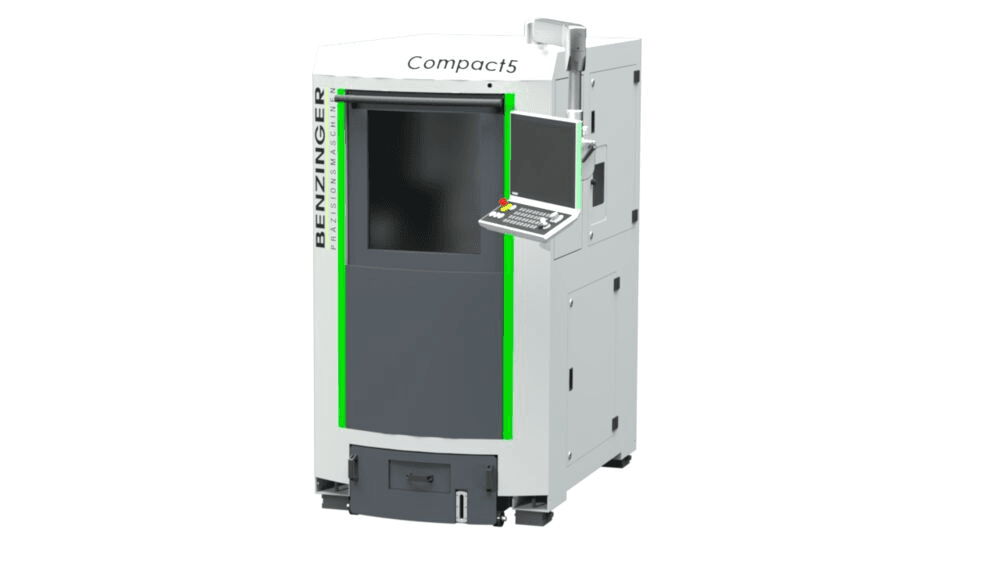
Compact 5-axis micro-machining is reshaping the economics of precision manufacturing. A newly integrated machining centre, the Compact5 from Benzinger, combines five-axis cutting, automated workpiece handling and high productivity on a footprint of just 1.4 square metres. It reflects a broader shift in manufacturing: smaller, smarter machines that deliver more output per square metre of floor space, with less manual work and higher repeatability.
Why compact micro-manufacturing is breaking through now
Demand for miniature components is rising across nearly every high-value sector. Think of implants and instruments in medical technology, connectors and housings in electronics, watch components, sensor enclosures and microfluidic parts. These components require tolerances in the micrometre range, complex geometries and surface finishes that simple machining cannot achieve.
At the same time, European manufacturers face high real-estate and energy costs, tight labour markets and pressure to bring production closer to home. A machine that delivers full five-axis CNC milling on less than one and a half square metres fits that reality precisely: maximum return from scarce space and scarce people.
What five axes and integration actually deliver
Five-axis machining means the workpiece is cut from multiple angles in a single setup. That brings immediate benefits:
- Fewer setups: every re-clamping introduces positioning errors. A single setup improves the dimensional accuracy of complex parts.
- Shorter lead times: fewer operations, less waiting, more unattended runtime.
- Better surfaces: favourable tool orientations reduce the need for finishing.
- More complex geometry: undercuts and freeform surfaces that are difficult or impossible in three axes.
Integrating automation and robotics completes the picture. Automated workpiece or pallet changing extends unattended production, reduces the impact of labour shortages and stabilises quality by removing human variation from the process. For small, high-value batches, that combination is exactly what drives down cost per part.
Implications for precision and quality assurance
In micro-manufacturing, the error margin shifts to micrometres. Thermal stability, vibration damping and machine rigidity then determine the difference between a usable part and scrap. A compact, rigid structure helps keep thermal and dynamic effects under control. Still, process control remains essential: in-process measurement, tool monitoring and a tightly regulated environment are not luxuries but prerequisites.
For manufacturers this means the investment in the machine must go hand in hand with investment in measurement and testing equipment and in suitable precision tooling. Micro-milling places high demands on tool selection, cutting data and tool life; the wrong tool or an unstable process destroys the advantage the machine promises.
Strategic considerations for European manufacturers
The rise of compact, automated micro-machining centres fits a clear trend: reshoring of high-value production, smaller batch sizes with higher mix, and growing emphasis on flexibility. For suppliers and OEMs there are concrete opportunities and considerations:
- Space efficiency: more machines in the same hall means more capacity without costly expansion.
- Energy and sustainability: smaller, targeted machines can lower energy use per part.
- Accessibility: integrated automation lowers the barrier for companies without a large automation team.
- Workforce: unattended production partly offsets the shortage of machinists, but requires new skills in programming and process monitoring.
Anyone considering such technology should view the business case broadly: not just the purchase price, but also lead time, scrap rates, unattended hours and the total footprint of the process. A machine running on 1.4 m² only truly pays off when it is embedded in a well-considered production and quality strategy.
For manufacturing, this development underlines that scaling up does not always mean building bigger. The competitiveness of European precision companies increasingly lies in smart, compact and automated production that makes complex, small components reliable and affordable — close to the customer and with a minimal footprint.