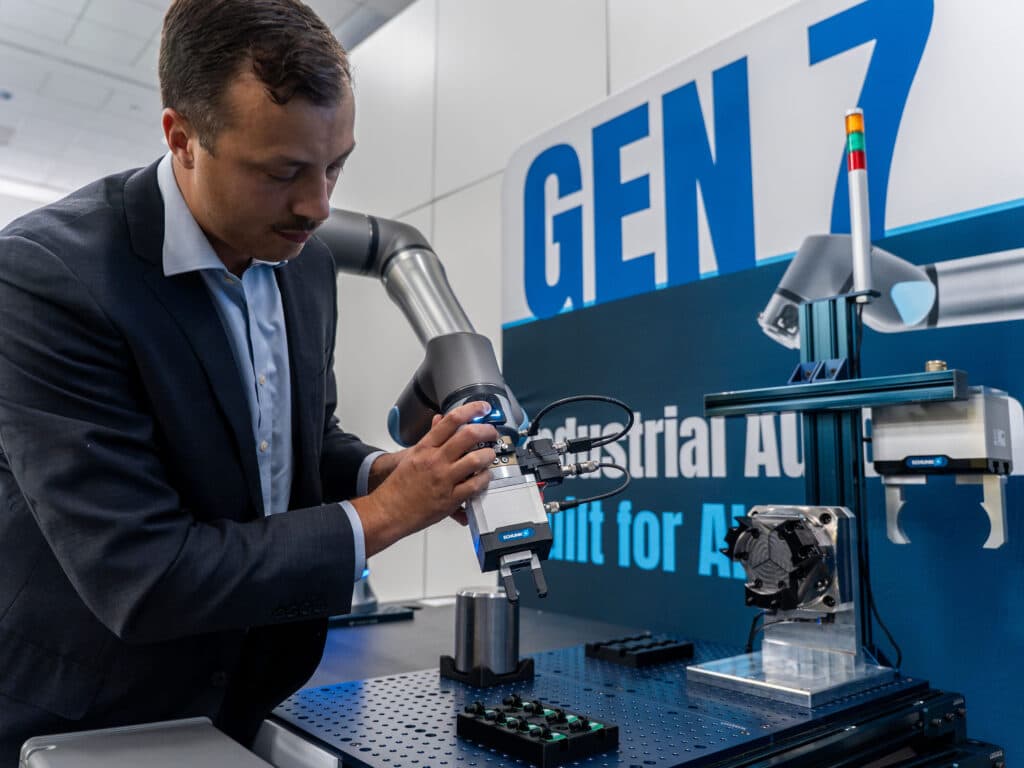
With Universal Robots Gen 7, the cobot manufacturer takes a decisive step toward physical AI: robots that do more than execute pre-programmed motions — they perceive their environment, interpret it and adapt. The seventh generation has reportedly been redesigned from the controller to the tool flange, with the explicit goal of making artificial intelligence deployable as standard in industrial applications. For production managers and engineers in metalworking, machine building and high-tech, this is more than a product update — it touches how robotisation and automation will take shape in the years ahead.
What 'physical AI' means on the shop floor
The term physical AI refers to the merging of software intelligence with moving hardware. Where traditional cobots operate within tightly defined boundaries, AI-driven systems must cope with variation: parts that sit slightly differently, changing lighting, or tasks that cannot be fully predicted. Making this possible requires three things:
- Compute close to the robot, so AI models and sensor data can be processed in real time without lag.
- Rich sensing, including machine vision and industrial AI, force-torque measurement and touch at the tool flange.
- Open software architecture that simplifies connecting external AI models and robot and machine software.
By building these blocks into the platform natively, Universal Robots lowers the barrier to actually bringing AI applications into production — the very point where many pilots stall today.
Why this generational leap arrives now
The timing is no accident. Manufacturing in the Netherlands and across Europe faces structural labour shortages, an ageing workforce and a drive to keep production closer to home. Automation is no longer optional but necessary. At the same time, the broader AI wave — from generative models to advanced image recognition — has matured enough to deliver value on the shop floor. Cobots are a logical vehicle: relatively affordable, safe to run alongside people and flexibly reprogrammable. A platform that supports AI out of the box answers precisely the need for systems that deploy faster and require fewer specialised programmers.
Concrete opportunities for European manufacturers
For SME manufacturers, which rarely have an in-house robotics department, an AI-driven cobot platform can be the difference between automating high-variation tasks or not. Consider:
- Flexible assembly of small batches, where reprogramming has traditionally cost too much time.
- Quality inspection where vision AI detects deviations that fixed rules miss.
- Pick-and-place from bulk, where parts arrive unordered.
- More complex operations such as robotic welding and material handling, where adaptability boosts reliability.
The real gain lies not in the robot itself but in shortened engineering time and broader deployability. Getting a cobot operational in days rather than weeks fundamentally changes the automation business case.
Risks and considerations for implementation
At the same time, realism is warranted. AI-driven robotics introduces new questions. Models that adapt must remain validatable and predictable — especially in safety-critical environments and under upcoming European AI and machinery regulation. Companies will need to focus on:
- Data quality and training: an AI cobot is only as good as the data it works with.
- Maintenance and lifecycle of software, updates and cybersecurity.
- Building internal expertise, or partnering for system integration and OEM outsourcing.
A new platform promises a lot, but value only emerges through thoughtful integration into existing processes, MES systems and safety concepts.
What this means for manufacturing
Gen 7 marks a shift: from cobots that do exactly what you program to systems that interpret situations and make decisions within limits. For European manufacturing, this is a chance to keep production competitive and flexible despite a tight labour market. It also raises the bar for engineering expertise, data management and governance. The companies that learn to experiment with physical AI now — starting small, measuring and scaling — build a lead that will become increasingly hard to close. Automation is thus becoming less an investment in hardware and more an investment in intelligence.