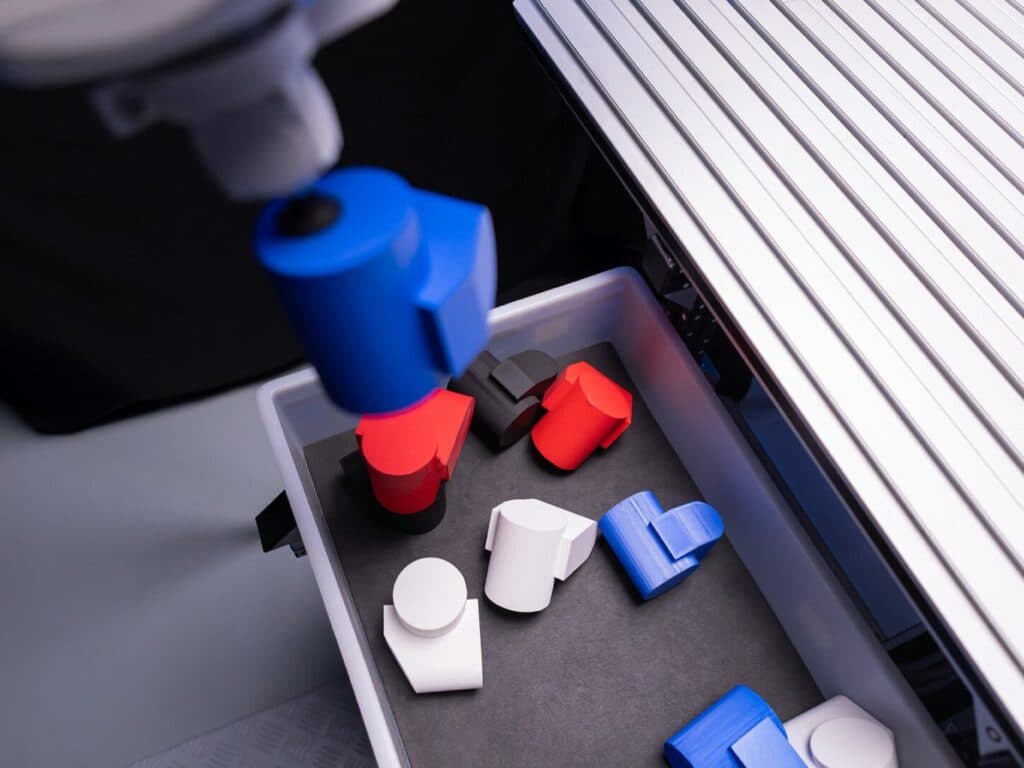
With the launch of OmniCore EyeMotion, ABB Robotics takes a clear step towards robots that actively perceive their surroundings. The solution allows any robot running on the OmniCore platform to 'see' what is happening around it using third-party cameras or sensors. In doing so, machine vision shifts from a separate, complex add-on to an integrated part of the robot controller — a development that lowers the barrier to flexible automation for many manufacturers.
What OmniCore EyeMotion adds to robot control
The heart of the announcement is integration. Where vision applications traditionally required their own software layer, separate controllers and extensive programming, EyeMotion builds vision functionality directly into the OmniCore ecosystem. That has several concrete consequences:
- Environmental awareness: the robot can locate objects, determine orientations and adapt its motion accordingly.
- Hardware freedom: because cameras and sensors from different vendors are supported, companies are less tied to a single brand.
- Lower integration threshold: fewer separate systems mean shorter commissioning and fewer mismatches between control and image processing.
For engineers working on robotisation and automation, this means vision is no longer a standalone project but a natural extension of the existing robot cell.
Why vision is becoming essential in automated production
Demand for vision-guided robots is growing because classic 'blind' automation copes poorly with variation. A robot without eyes performs exactly the same movement, again and again — ideal for large, identical batches, but fragile as soon as products differ slightly in position, shape or size. Especially in Europe, where high-mix, low-volume production is the norm, that rigidity is a barrier.
With integrated machine vision and industrial AI, robots can handle imprecisely presented parts, perform bin picking, inspect quality during the process and adapt to changing workpieces. This opens up applications that previously remained manual, from complex assembly to inspection and material handling.
Implications for European manufacturers
For manufacturers in the Netherlands and across Europe, this development addresses two persistent challenges: the shortage of technical staff and the pressure to produce smaller batches profitably. Vision-guided robots reduce reliance on manual operations and make automation viable at production volumes that were previously too small to justify the investment.
In practice, this creates opportunities for:
- Flexible robot cells that switch to another product without extensive reprogramming.
- In-line quality control, where deviations are detected immediately rather than afterwards.
- Applications such as robot welding, where accurately locating seams and workpieces makes the difference between a stable and an error-prone process.
At the same time, there are points to watch. The choice of suitable sensors and actuators, lighting within the cell and the quality of image processing ultimately determine whether a vision application performs reliably. A more open ecosystem helps, but does not replace the engineering expertise needed to make image, control and mechanics work together properly.
The broader trend: robots that understand context
OmniCore EyeMotion fits a clear movement within automation: from robots that blindly work through a series of coordinates to systems that interpret their surroundings and respond. This shift is driven by cheaper cameras, more powerful processors and maturing AI for image analysis. By anchoring vision in standard robot software, ABB narrows the gap between advanced research applications and everyday practice on the shop floor.
Companies looking to expand their automation would be wise to think early about the software layer. A robust platform for robot and machine software makes it easier to add future vision and AI features without replacing the entire installation.
For manufacturing, the arrival of integrated robot vision means flexible automation becomes more accessible and affordable. Businesses that invest now in vision expertise and scalable control platforms build an edge in a market where adaptability increasingly determines competitive position.