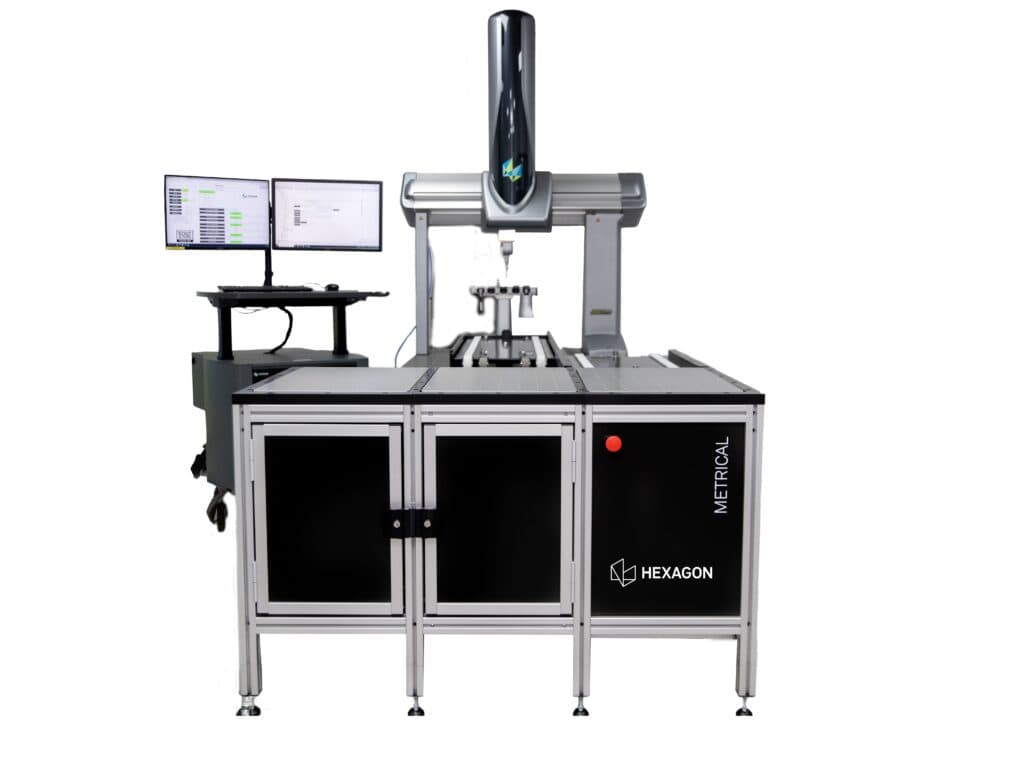
With Metrical, Hexagon takes another step in CMM automation: a system for automatic loading and queue management that keeps coordinate measuring machines (CMMs, also called 3D measuring machines) running almost continuously. Where a measurement room traditionally depends on an operator to load parts, align them and start measuring routines, inspection now shifts to an unmanned, continuous process. The result is higher inspection capacity without the need for extra measuring machines or extra staff.
What Metrical adds to the metrology lab
The core idea is simple to summarise: parts are placed in a queue in advance, after which the CMM inspects them automatically, one by one. This allows a measuring machine to keep running at night and during breaks. In practice, that delivers several benefits:
- Higher utilisation of expensive measuring equipment — the machine stands idle less often.
- Shorter lead times, because inspected parts do not wait for an available operator.
- More consistent results, as human variation in loading and alignment decreases.
- Better predictability of quality control within production planning.
For companies investing in measuring and testing equipment, this matters: the payback time of a CMM depends heavily on how fully it is used. A machine that only measures during the day shift taps into a fraction of its potential.
Why CMM automation is breaking through now
The rise of these systems does not stand alone. In many manufacturing plants, production is already highly automated through machining centres with pallet changers and robotisation and automation, while quality control lagged behind. The metrology lab became a bottleneck: automated machining, but manual measuring. Metrical fits the broader trend of bringing inspection and approval into the automated flow as well, so the entire chain from machining to quality assurance runs seamlessly.
Structural factors also play a role. The shortage of qualified metrology technicians across Europe makes unmanned inspection attractive. At the same time, sectors such as automotive, aerospace and medical technology impose ever stricter requirements on traceability and accuracy. Automation helps handle these larger measurement volumes without costs rising proportionally.
Implications for European manufacturers
For suppliers in metal and machine building, automatic CMM loading changes the playing field. A small or medium-sized company that previously considered 100 percent inspection unrealistic can now, with queue-driven inspection, measure a larger share of production rather than sampling. That lowers the risk of defects and strengthens their position with demanding customers.
There are points to watch, however. Unmanned inspection requires reliable fixturing, robust measuring routines and good alignment with the overarching quality system. The real gain emerges when measurement data flow straight back into production — for example into an MES or production software environment — so deviations quickly trigger process corrections. Automatic measuring without a closed loop mainly produces more data, not better quality.
- Invest in standardised fixturing so parts fit into the queue reproducibly.
- Ensure calibrated and validated measuring programs; unmanned measuring amplifies the consequences of a flawed routine.
- Link measurement data to SPC and process control to extract real value from the added capacity.
- Account for calibration and certification of measuring instruments to stay audit-proof.
Measurement as part of the smart factory
Metrical illustrates how quality control is shifting from a separate, manual step to an integrated link in the smart factory. As machine vision and industrial AI mature, a continuous measurement landscape emerges in which data from CMMs, scanners and vision systems converge. That enables predictive quality management: spotting deviations before they lead to scrap.
For the manufacturing industry, the message is clear. Automating inspection is no longer a luxury for large corporations but a concrete way to raise capacity, consistency and competitiveness. Companies that experience their metrology lab as a bottleneck would do well to seriously weigh loading and queuing automation — not as a standalone investment, but as part of a continuous, data-driven quality strategy.