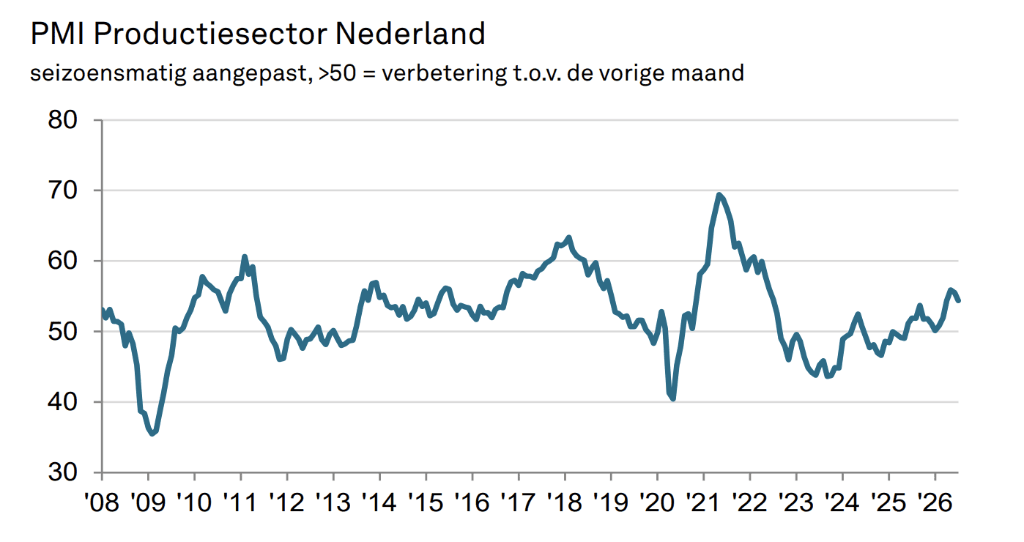
Dutch industry exports are surging, driven by sustained strong output growth. After a sharp rise in production volume in July — the biggest since early 2022 — output climbed again in August. Export orders stand out in particular: they grew at their fastest pace in more than four years. The machine-building industry, and especially demand for chipmaking equipment, is a key engine behind this recovery.
Export orders as the driver of industrial recovery
The fact that growth is now coming mainly from export orders is telling. Dutch manufacturing is strongly internationally oriented: a large share of revenue is earned abroad. When foreign buyers step up their orders, it usually signals that demand in key markets — Germany above all — is picking up. For suppliers, this means order books are filling and capacity planning becomes a concrete concern once again.
At the same time, caution is warranted. One strong month does not make a structural trend. Geopolitical tensions, trade barriers and volatile energy prices can quickly slow the recovery. Companies investing now would do well to keep those investments flexible and scalable.
Machine building and chipmaking equipment lead the way
Demand for chipmaking machines is remarkably robust. The worldwide need for semiconductors — for vehicles, data centres, artificial intelligence and industrial automation — translates into orders for the machines used to produce chips. The Netherlands holds an exceptionally strong position here, and this radiates across a broad network of suppliers.
That network includes, among others:
- firms in special machine building that design and build complex systems;
- high-precision machinists specialising in CNC milling and fine mechanics;
- providers of system integration and OEM outsourcing.
This chain benefits fastest from rising machine orders, because a single system delivery triggers hundreds of parts and operations at suppliers.
What this means for the wider manufacturing sector
Growth in the front-runners trickles through to the rest of the sector. As demand for machines and modules rises, so does the need for parts, semi-finished goods and surface treatment. Suppliers feel this first in their quotation requests. For production managers, several concrete priorities emerge:
- Capacity and lead times: rising orders put pressure on throughput. Those who make agreements with suppliers now will be in a stronger position later.
- Staff and expertise: the tight labour market remains a brake on growth. Investing in robotisation and automation helps scale up production without proportionally more staff.
- Inventory and purchasing: after years of disrupted supply chains, a well-considered sourcing strategy for raw materials and components is crucial.
Opportunities and risks for Dutch and European manufacturers
The recovery offers clear opportunities. Companies that invested in productivity, digitalisation and sustainability in recent years can now scale up without hitting cost ceilings. The emphasis on strategic autonomy within Europe — with semiconductors as a key technology — also works in favour of the Dutch supply chain.
The risks, however, are real. Heavy reliance on a limited number of sectors and buyers makes the industry vulnerable to sudden reversals. A downturn in the chip market or new trade restrictions could quickly stall the export engine. On top of that, energy costs and the availability of technical staff remain structural challenges.
For manufacturing, this development means above all that the momentum is there, but capitalising on it requires discipline. Companies that organise their capacity wisely, engage reliable suppliers in good time and keep investing in automation will turn current growth into a durable competitive position. Those looking to start a concrete project can request quotes from specialised partners and respond to the rising demand.