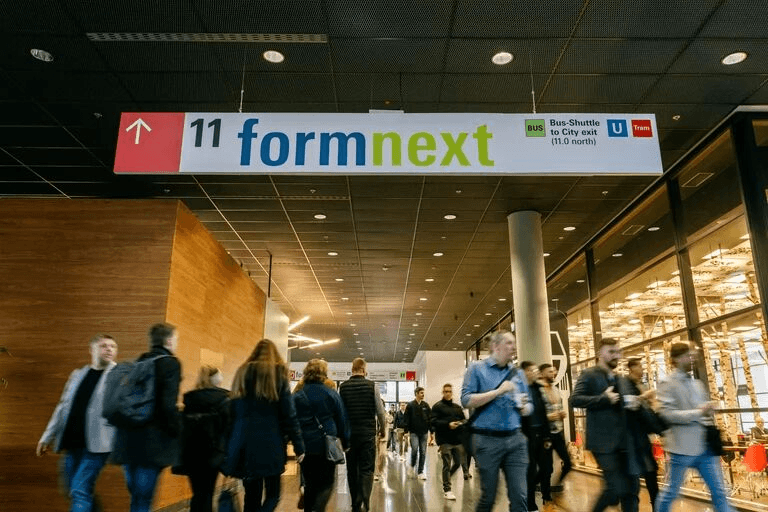
As Formnext 2026 approaches, anticipation around metal 3D printing is building fast. Leading manufacturers are deliberately keeping their newest systems under wraps, yet the direction of travel is already clear: larger build volumes, faster build rates, smarter process monitoring and tighter integration into existing production lines. For manufacturers across Europe this is no sideshow — the technology is moving from prototyping toward genuine series production.
Why metal 3D printing is coming of age
Over the past few years, metal 3D printing has shifted from an experimental niche to a serious production technology. Several factors drove this. Hardware became more reliable, powders cheaper and more widely available, and the software for build preparation and simulation more mature. As a result, companies can now predict with far greater confidence how a part will behave during printing — essential for quality and repeatability.
The expected highlights fit this trajectory. Think of:
- More laser sources per machine, sharply increasing build speed and lowering cost per part.
- Larger build chambers, enabling components previously only feasible through casting or machining.
- Integrated quality monitoring with sensors and cameras that track the melt pool in real time.
- Automation of pre- and post-processing, from powder handling to support removal.
From prototype to series production
The most important shift is strategic. For a long time, 3D printing was used mainly for prototyping and rapid manufacturing. Now manufacturers are positioning their systems explicitly for series production. That demands a different mindset: not one spectacular part, but reproducible quality across hundreds or thousands of units, with predictable lead times and a solid business case.
For manufacturers, this means additive production increasingly sits alongside conventional methods. A part can be built additively and then finished to size and tolerance through CNC milling. This hybrid approach — printing where it adds value, machining where precision matters — is becoming the new normal.
Impact on material choice and the supply chain
Metal 3D printing unlocks geometries impossible with casting or milling: internal cooling channels, lattice structures for weight savings, and function integration that merges several parts into one component. This directly affects the choice of metals and the broader supply chain. The availability and quality of metal powders — from stainless steel and titanium alloys to nickel-based superalloys — largely determines what is technically and economically feasible.
At the same time, the supplier's role is changing. Where companies once ordered a casting or forging, they now increasingly request a printed, finished and certified part. That shifts responsibility for quality, documentation and traceability to the supplier — and makes testing, inspection and NDT an indispensable final step in the process.
Opportunities and risks for European manufacturers
The opportunities are real. Additive production shortens development times, enables local manufacturing of spare parts and reduces dependence on fragile international supply chains. That last point carries weight at a time when supply security and reshoring sit high on the agenda. A printable part produced on demand lowers inventory costs and lead times.
At the same time, there are pitfalls. Investment in machines, powder infrastructure and trained staff is substantial. Not every part suits additive production; the business case is strongest for complex, high-value or low-volume components. Companies are wise to screen their part portfolio critically rather than diving in broadly. Design also demands new expertise: only those who design for additive manufacturing truly capture its potential.
For the manufacturing sector, the run-up to Formnext 2026 marks a turning point. Metal 3D printing is no longer a gadget but a production-ready technology firmly establishing itself alongside casting, machining and welding. Manufacturers who build knowledge now, run pilots and reorient their supply chains will emerge stronger. The question is no longer whether additive metal manufacturing matters, but where and how quickly it becomes embedded in their own production.