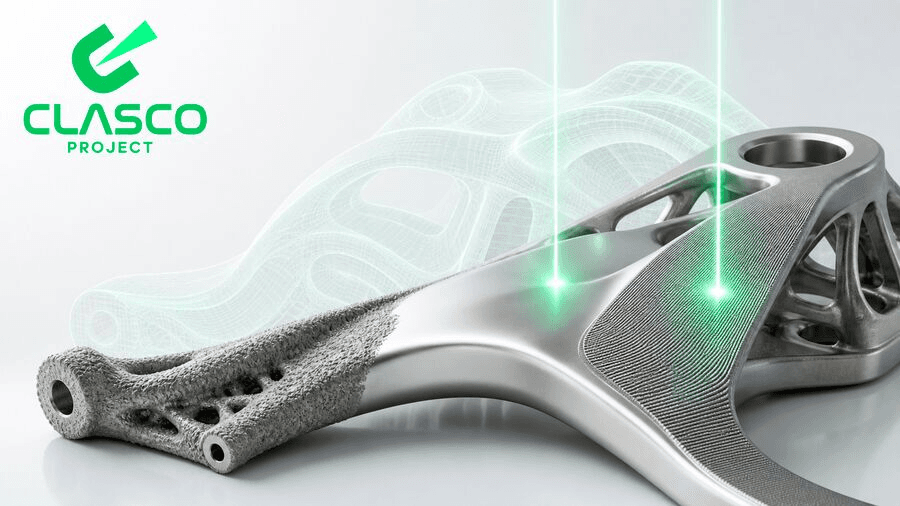
The post-processing of 3D-printed metal parts has long been the underrated bottleneck of additive manufacturing. A European research consortium coordinated by TU Dresden is now specifically targeting laser-based finishing of complex, geometrically demanding metal components that conventional methods can barely reach. In doing so, the project addresses a pain point that has held back the wider industrial breakthrough of metal 3D printing.
Why finishing is the Achilles heel of additive manufacturing
Metal printing techniques such as laser powder bed fusion build parts layer by layer. This delivers unrivalled design freedom: internal channels, lattice structures, integrated functions and topology-optimised geometries that would be impossible with machining or casting. The downside is surface quality. Straight out of the machine, parts show rough surfaces, adhering powder, staircase structures and residual stresses. For many applications — think sealing faces, flow channels or medical implants — that is unacceptable.
Traditionally this is solved with mechanical processes such as grinding and honing, polishing or re-machining on a CNC milling machine. And that is precisely where the friction lies: tools and abrasive media cannot reach internal cavities, undercuts or fine lattice structures. The very complex geometries that make 3D printing so valuable are the hardest to finish with conventional methods.
Laser as the key to hard-to-reach surfaces
Using laser energy promises to change this. A focused, contactless beam can smooth surfaces without a physical tool needing to fit into the cavity. This opens the door to finishing geometries that were previously simply out of reach. The core of the research is to make this process controllable across a range of alloys, wall thicknesses and shapes.
The potential benefits for manufacturers are concrete:
- Access to internal structures that mechanical methods cannot reach;
- Contactless processing without tool wear or deforming forces on thin walls;
- Better repeatability through digitally controllable process parameters;
- Shorter process chains as manual rework is partly eliminated.
Where this fits in the broader additive manufacturing trend
This development fits a clear movement: metal 3D printing is shifting from prototyping to series production. As long as post-processing remains labour-intensive, manual and unpredictable, the total cost per part stays high and scaling remains limited. Finishing often accounts for a significant share of a printed part's lead time and unit cost. Every step towards automated, repeatable finishing lowers that barrier.
This matters for sectors such as aerospace, medical technology, energy and high-tech. There, the focus is on complex, high-value components in small series, where the design freedom of printing truly pays off but where requirements for surface finish, fatigue strength and dimensional accuracy are strict. A reliable laser finishing process can fundamentally improve the business case for additively manufactured functional parts.
Consequences for European manufacturers
For the European manufacturing industry, the timing is favourable. Europe is investing heavily in sovereign, high-quality production technology and in reshoring critical manufacturing. Additive techniques fit that agenda: shorter chains, less material waste and on-demand production. But competitiveness depends on mastering the entire chain — from powder to finished, qualified part.
Companies serious about additive manufacturing would do well to rethink their finishing strategy now. Practical points to consider:
- Deliberately design parts for post-processing (design for post-processing) so that critical surfaces remain accessible;
- Involve finishing and quality inspection partners early, especially for qualified applications;
- Combine prototyping and rapid manufacturing with a realistic estimate of the rework effort required;
- Track emerging laser and hybrid finishing methods to avoid being locked into labour-intensive manual steps.
The message for the manufacturing industry is clear: the value of metal 3D printing is only fully unlocked when finishing keeps pace. Research into laser-based finishing of complex geometries is therefore not a side issue but a crucial link in moving additive manufacturing from a promising technology to a mature, industrially scalable process platform.