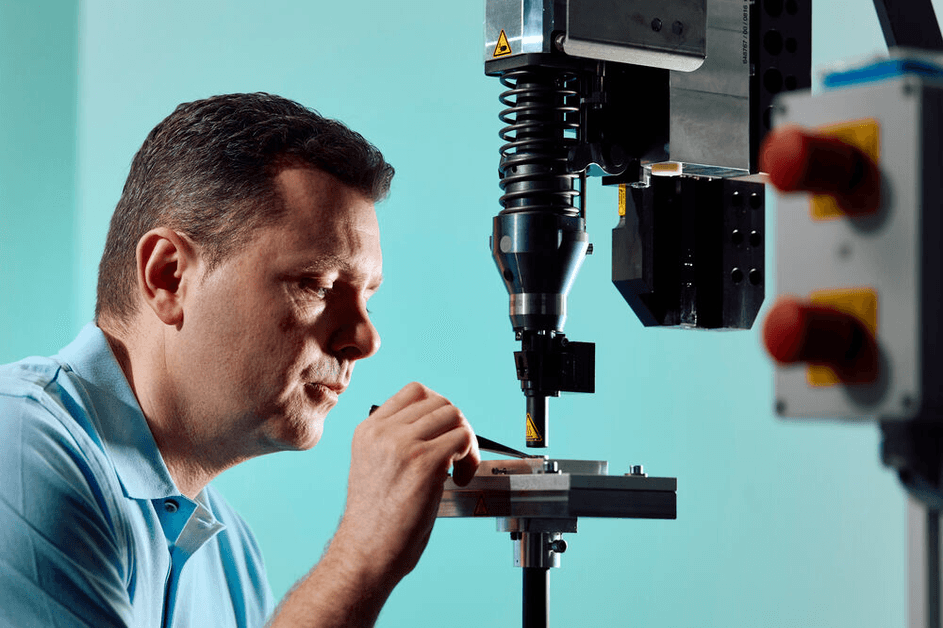
Friction stir welding is evolving from a specialist joining technique into a modular innovation platform that lets manufacturers move new material combinations into series production much faster. Where individual projects once each demanded their own development path, a reusable foundation is now emerging: modules for process control, tooling and quality assurance that can be combined again and again. For European welding technology, that marks a fundamental shift, with consequences for lead times, costs and product design.
What sets friction stir welding apart
In friction stir welding, a rotating tool joins materials in the solid state without fully melting them. This approach offers clear advantages over conventional fusion welding:
- Less thermal distortion, because the process stays below the melting point.
- Strong, dense seams with a fine grain structure and low porosity.
- Suited to difficult combinations, including aluminium and other non-ferrous metals that are hard to process with fusion welding.
- No filler material or shielding gas required, making the process cleaner and more reproducible.
This is especially attractive when working with light metals and mixed constructions. As a result, the method is gaining ground in sectors where weight reduction and reliable joints come together — from e-mobility to energy storage.
From one-off project to reusable platform
The core of the modular idea is that you do not build every new application from scratch. Instead, knowledge about process parameters, tool geometry and quality control is captured in building blocks that can be recombined. A new material pairing then becomes a variant on an existing foundation rather than a multi-year R&D effort.
This approach aligns with a broader trend in manufacturing: modularisation and platform thinking. Companies that systematically unlock their process knowledge sharply reduce the time between a material idea and a qualified application. That is precisely the stage where many innovations stall today — something is technically feasible, but the path to reproducible series production is too long and too costly.
Why this matters for European manufacturers
For Dutch and German manufacturers, this development touches several strategic themes at once. Sustainability calls for lighter constructions and joints that do not hinder recyclability. Electrification places high demands on thermally and electrically conductive connections, for example in battery housings and cooling plates. And pressure on costs and delivery times makes any reduction in the qualification path immediately valuable.
A modular approach offers concrete opportunities:
- Faster product introduction through reuse of proven modules.
- Lower development risk, because process windows are already documented.
- Better scalability towards automated robotic welding cells.
- More design freedom for engineers working with hybrid material combinations.
At the same time, there are prerequisites. Friction stir welding demands robust, rigid machine setups and precise clamping of the parts to be joined. The investment in equipment and process know-how is significant, and the benefits come into their own mainly for series work or applications where conventional welding simply falls short. For small, one-off jobs, classic welding often remains more economical.
The role of quality assurance and engineering
A platform approach stands or falls on reliable quality data. Because friction stir welding is a solid-state process, attention shifts from visual seam inspection to monitoring process parameters such as spindle speed, feed and force. Companies that capture this data systematically build a dataset that speeds up qualification of future applications. This makes cooperation with partners in testing, inspection and NDT and with early product design and engineering partners increasingly important: the joining choice ideally belongs in the design phase, not on the shop floor.
For the manufacturing industry, the message is clear. The real competitive advantage lies not only in the technology itself, but in the ability to make knowledge reusable. Companies that turn their welding expertise into modular, documented processes shorten the path from material innovation to series production — and that speed is exactly what is needed to stay ahead in sustainability and electrification.