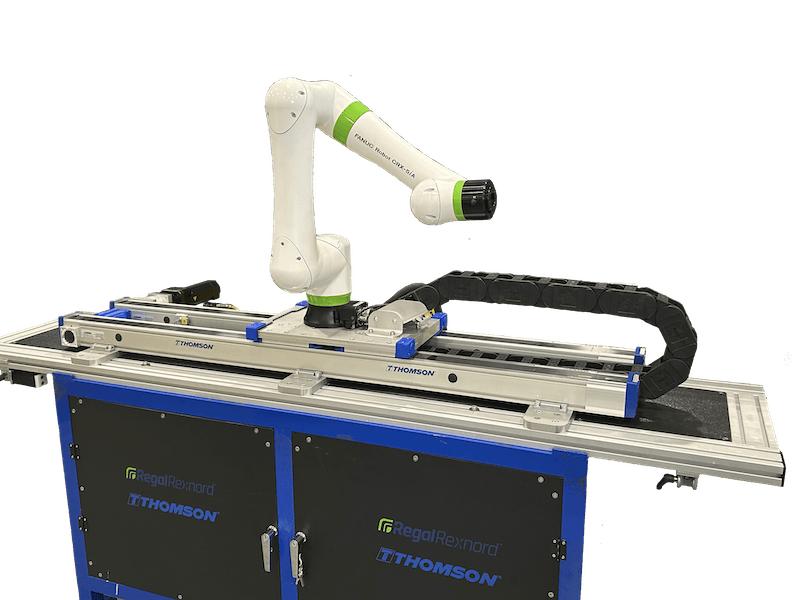
An integrated linear axis for CRX cobots marks a new step in how manufacturers deploy collaborative robots. Regal Rexnord and Fanuc are combining their expertise into a ready-to-use solution that lets Fanuc CRX-series users move their cobot along a linear track. The axis pairs Thomson linear motion technology with Boston Gear gearheads, Huco couplings and Kollmorgen motors and software. The result is a so-called seventh axis that substantially expands a cobot's working range, without requiring integrators to match components from different suppliers themselves.
What a seventh axis adds to collaborative robots
A collaborative robot typically has six motion axes and a fixed, circular working envelope. Placing the robot on a linear axis creates a seventh degree of freedom: the cobot travels along a rail and can serve multiple workstations, machines or pallets. For manufacturing this means, in practical terms:
- Greater reach — one cobot serves several CNC machines or assembly positions instead of just one.
- Higher utilisation — expensive robot capacity is spread across more tasks, shortening payback time.
- Flexible layouts — production cells can be built more compactly and modularly.
Within robotics and automation, this expansion is especially valuable for companies with small batches and frequent changeovers, where a fixed setup quickly reaches its limits.
Why a pre-integrated solution matters
The biggest gain lies not only in the hardware but in the integration. Traditionally, a system integrator has to combine, tune and program a linear guide, drive, couplings, motor and controls from different brands. That takes engineering time, introduces compatibility risks and lengthens lead times. A solution in which the drive technology, guidance and software arrive as one validated package lowers that barrier considerably. For European manufacturers with limited in-house automation expertise this is significant: complexity shifts from the shop floor to the supplier.
This aligns with a broader trend. Component makers increasingly position themselves as providers of complete sub-solutions rather than individual parts. For end users that lowers the entry barrier to automation; for traditional system integration and OEM outsourcing, the playing field shifts because part of the integration work is already done.
The role of precision in linear motion
The performance of a cobot on a linear axis depends on the quality of its guidance and drive. Backlash, stiffness and repeatability determine whether the robot returns to exactly the same position after travelling. Precise bearings and guides, low-backlash gearheads and rigid couplings are therefore crucial. Collaborative applications add a safety dimension: the robot shares its space with people, so its motion along the axis must remain predictable and controllable, including during acceleration and braking.
Broader context: cobots as a growth driver
Collaborative robots are among the fastest-growing segments in industrial automation. They are cheaper, quicker to commission and safer alongside operators than classic industrial robots behind fencing. That fits the reality of many European manufacturers: a tight labour market, rising wage costs, high product mix and a need for flexibility. A linear axis increases cobot versatility precisely in these situations, because one robot can take on multiple tasks without extra operators.
At the same time, nuance is warranted. A seventh axis adds moving parts, maintenance and cable management. Companies should calculate the business case per application: does it match the cycle times, is repeatability sufficient, and does it deliver enough added utilisation to justify the investment?
What this means for manufacturing
For production managers and engineers, an integrated linear axis lowers the barrier to deploying cobots more widely. The pairing of validated hardware and software shortens implementation time and reduces technical risk. Those considering automation can scale faster from a single robot cell to a more flexible setup. The key message: automation is becoming more modular and accessible, but a sound assessment of utilisation, accuracy and maintenance remains decisive for the return.