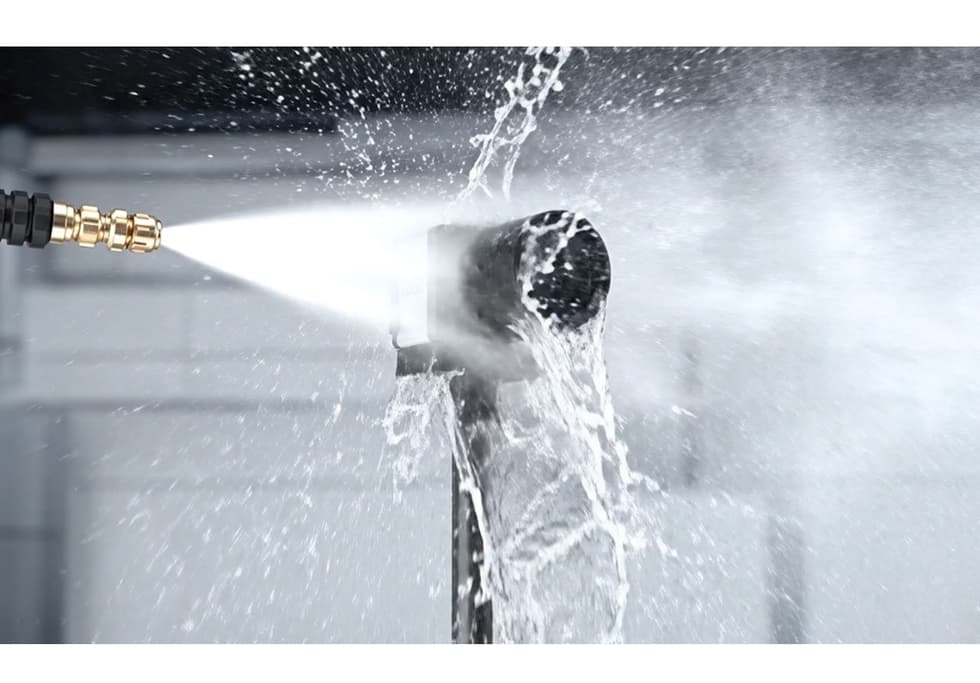
Robust machine vision for demanding production environments is gaining new momentum: the expansion of the uEye FA series with cameras that combine IP69K protection with the latest Sony STARVIS 2 sensors. These models are designed for conditions where standard cameras fail — high-pressure cleaning, dust, moisture and sub-zero temperatures — and cover resolutions from 2 to 12.5 megapixels. For European manufacturers looking to automate inspection and process monitoring without compromising reliability, this is a relevant development.
Why IP69K makes the difference in harsh environments
The IP69K rating represents the highest degree of dust and water resistance within the common IP classification. Unlike IP67 or IP68, IP69K guarantees protection against high-pressure and steam-jet cleaning at close range — exactly what occurs daily in the food, pharmaceutical and chemical industries. In those sectors, production lines are cleaned frequently and aggressively to meet hygiene requirements. A camera housing that cannot withstand this leads to failure, corrosion and unplanned downtime.
With a fully sealed, smooth and gap-free housing, these cameras can be placed directly in the production zone without separate protective covers or compressed-air flushing. That simplifies the mechanical assembly of inspection stations and reduces the maintenance burden — a real advantage when downtime translates directly into lost money.
Sony STARVIS 2: image quality under difficult light
The real technical leap lies in the sensors. Sony's STARVIS 2 rolling shutter sensors are engineered for high dynamic range and excellent light sensitivity. This delivers sharp, low-noise images even under variable or dimmed lighting — a recurring problem in factory settings with reflections, shadows and steam. The range spans resolutions from 2 to 12.5 megapixels, serving applications from fast presence checks to fine detail inspection.
- High dynamic range: details remain visible in both dark and brightly lit image areas.
- Better signal-to-noise ratio: more reliable detection at short exposure times.
- Scalable resolution: a single camera platform for diverse inspection tasks.
What it means for automation and quality control
Machine vision is the sense organ of the modern factory. Without reliable image capture, every form of automated inspection, robot guidance or process control stalls. Robust cameras that withstand the cleaning and climate conditions of the shop floor lower the threshold to introduce robotics and automation in places that were previously considered too dirty or too wet.
For companies investing in automated quality control and inspection, this aligns with a broader trend: the demand for 100% inline checking rather than sampling. Higher resolutions and better imaging under difficult light make it possible to detect defects earlier, reduce scrap and improve traceability. Combined with smart sensors and actuators, this creates closed-loop control systems that adjust processes in real time.
Broader trends: hygienic design and Industry 4.0
The rise of such cameras fits two mutually reinforcing developments. First, hygiene and food safety rules are tightening requirements for equipment in the process industry; hygienic design and cleanability are becoming design principles rather than afterthoughts. Cameras that withstand industrial cleaning fit seamlessly into that philosophy.
Second, the digitalisation of production demands ever more data points. Image sensors deliver rich, contextual data that becomes increasingly valuable with AI-driven image analysis. Robust hardware at the network edge is the prerequisite for keeping that data stream flowing reliably. For system integrators and OEMs, a wider choice of sensors means more freedom to build tailored vision solutions.
What this means for the manufacturing industry
For European manufacturers, more robust machine vision lowers the barrier to automating inspection in the most demanding parts of the factory. Those producing in wet, dusty or cold environments can move quality control further inline, reduce scrap and meet stricter hygiene and traceability requirements. The combination of maximum protection rating and state-of-the-art image sensors enables reliable vision precisely where automation delivers the greatest value — a concrete step in the ongoing digitalisation of production.